

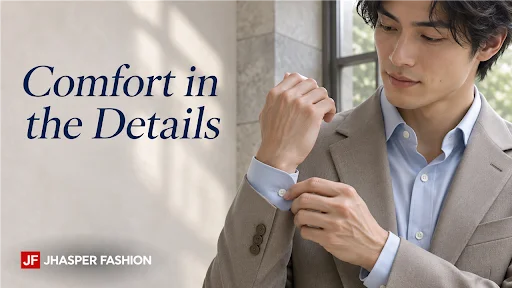
In a hypothetical morning at a desk, a man loosens his collar before opening his email. Later, his cuff catches on his watch as he reaches for a coffee. By lunch, he has tucked the same section of shirt back into his pants several times. None of these moments looks dramatic in a mirror. Together, they suggest a more useful starting point for a shirt consultation than a demand to look slimmer: describe what keeps interrupting the day.
Notice What You Keep Adjusting
An adjustment is a clue, not a diagnosis. Pulling at the collar might reflect how it feels buttoned, the way the shirt sits, or simply a preference that was never discussed when it was chosen. The wearer does not need to identify the construction issue before speaking to a tailor. He needs to explain the moment clearly. A collar that feels comfortable open but distracting with a tie supplies more useful information than the general statement that the shirt is wrong.
The same applies to a hem that escapes during an ordinary task. Notice whether it happens after sitting, reaching, or walking, and how you normally wear the shirt. Tucked and untucked use do not ask exactly the same thing about the garment. A shirt chosen for an untucked weekend may not behave as expected when pressed into service beneath office pants. Describing the intended use helps prevent one vague request from concealing two different expectations.
There is no need to catalog every wrinkle. Fabric moves when the body moves, and clothing does not stay in a freshly arranged position all day. What deserves attention is the repeated interruption: pressure that makes you undo a button, fabric you keep pulling into place, or a cuff you avoid moving past your watch. A few specific observations are enough to begin a conversation without turning getting dressed into a daily inspection exercise.
Bring Your Daily Accessories Into the Conversation
The watch in the opening example is part of the shirt’s working environment. If you wear one regularly, bring that actual watch rather than describing it as large or small. The cuff needs to be considered alongside the object it encounters, not merely around an empty wrist. A tailor can discuss the relationship with you; a rule based on another person’s wrist or watch cannot establish the room that feels right on yours.
Other familiar pieces can clarify the intended use too. A shirt worn with a tie should be considered with the collar buttoned, while a shirt worn under a jacket needs to feel agreeable in that combination. If you normally wear an undershirt, mention it. These details are not accessories to the discussion in the figurative sense. They help explain what the shirt will be asked to accommodate once it leaves the quiet conditions of a fitting room.
Existing clothes can be useful references without becoming patterns to copy. Perhaps one shirt has sleeves you like but a body you find cumbersome. Another feels easy through the torso but needs constant retucking. Explain those differences rather than handing over a favorite with a request to make everything identical. The aim is to preserve the qualities that work while allowing the tailor to assess the rest, including the way the parts affect one another.
Describe Comfort Without Asking for a Baggy Shirt
Comfort is not a single size category. Someone may want more freedom through one area while enjoying a relatively close outline elsewhere. Asking for a bigger shirt can obscure that distinction, just as asking for a slimmer one can overlook the movements it must allow. Use the language of experience first: the fabric feels resistant when I reach across the desk, or the waist feels roomy while the upper back does not.
That kind of description gives a consultation about custom shirts at Jhasper Fashion a concrete subject. You are not arriving with a homemade pattern or a universal measurement to impose. You are explaining where the current shirt stops being comfortable and what appearance you would like to retain. The tailor can then discuss possible changes in relation to the garment, rather than having to infer what you mean by relaxed, neat, or fitted.
The answer may involve a compromise worth seeing and feeling. More room can change the outline; an adjustment in one place can alter how another area behaves. A little explanation is more useful than an assurance that every preference can be satisfied simultaneously. The wearer’s role is to say which sensations matter and to respond honestly during the fitting. You do not have to choose between accepting distraction and requesting an undefined amount of extra fabric everywhere.
Test the Shirt in Ordinary Moments
A calm fitting offers the opportunity to repeat the actions that made the old shirt noticeable. In the imagined desk day, the wearer would reach naturally for something nearby and sit as he usually does, rather than performing a set of extreme stretches. He would try the cuff with the watch in place and consider the collar in the way he expects to wear it. The point is recognition: does the shirt feel different in the moments that prompted the conversation?
When something remains distracting, describe it before smoothing it away. The mirror can show a change in the fabric, but the wearer is the only person who can explain the sensation. Equally, resist expecting a shirt to stay motionless while you move. A useful assessment leaves room for ordinary folds and shifts while identifying pressure or restriction that needs discussion. This is observation in familiar circumstances, not an examination the body has to pass.
Once the shirt is home, follow its care instructions and notice how it behaves in actual use. Any later feedback will be more helpful if it names a moment rather than declaring the whole garment a success or failure. The quiet ambition is not a shirt that can promise to remove every annoyance forever. It is clothing that asks for less repeated attention, leaving the wearer freer to notice the morning, the coffee, and the work instead.
