

Influencer marketing has become an important part of how businesses introduce products, connect with potential customers, and build trust online. Instead of relying entirely on traditional advertisements, companies increasingly look for opportunities to work with bloggers, content creators, product reviewers, and social media personalities who already have relationships with particular audiences. This approach allows businesses to communicate their message through people whose opinions and recommendations their followers may value.
Tomoson is a name associated with this type of marketing. Historically, it operated as an influencer marketing marketplace that brought businesses and content creators together. Brands could introduce promotional campaigns, offer products for testing or review, and identify influencers who matched their target audience. Influencers, in turn, could discover promotional opportunities, apply for suitable campaigns, receive products or other agreed compensation, and create content based on their experiences.
So, how does Tomoson work, and what made its original business model attractive to both sides?
The basic idea was to simplify the collaboration process. Rather than searching for individual bloggers across the internet, contacting them separately, and managing every interaction through different communication channels, brands could use a centralized marketplace to organize promotional opportunities. Creators could also explore campaigns without having to approach every company individually.
However, understanding Tomoson requires an important distinction between its historical marketplace functionality and its present-day website. Its public pages still contain campaign descriptions, pricing information, and account-related FAQs, but its current availability as a functioning marketplace is not reliably established. Anyone considering using it should verify that registration, applications, communication, and campaign management actually work before making a commitment.
This guide explains how the original Tomoson system operated, what brands and influencers could expect from it, how campaign collaborations were organized, and what readers should consider before choosing an influencer marketing platform.
What Is Tomoson?
Tomoson is a platform historically associated with influencer marketing, blogger outreach, product promotion, and online brand collaborations. Its original purpose was to help businesses find content creators who could introduce their products to relevant audiences.
The platform followed a marketplace approach. Companies could create promotional campaigns describing what they wanted to achieve and what type of creators they were looking for. Influencers could then explore available opportunities and apply when their interests, audience, and capabilities matched a campaign’s requirements.
For example, imagine a small business selling skincare products. The company wants more people to become familiar with a newly introduced moisturizer. Rather than purchasing advertisements immediately, it could look for beauty bloggers, skincare reviewers, or social media creators who regularly discuss similar products.
A marketplace such as the original Tomoson provided a structured way to organize these relationships. The business could describe its product, explain the campaign requirements, and consider applications from interested creators.
The process was designed to benefit both participants:
- Businesses: They could discover potential promotional partners, organize product campaigns, and collect content from creators.
- Influencers: They could find opportunities to work with businesses, test products, and develop content around brands relevant to their audiences.
- Small companies: They could explore influencer marketing without necessarily hiring a large marketing agency.
- Bloggers and reviewers: They could find promotional opportunities that matched their content categories.
Tomoson was particularly associated with product-based collaborations. These could involve receiving a product for testing, publishing an honest review, producing social media content, or completing another clearly defined promotional activity.
It is important to understand that Tomoson was not simply an online store where customers purchased products. Its original marketplace model focused on connecting businesses with creators who could produce promotional content and communicate their experiences to an audience.
How Does Tomoson Work?
The simplest way to understand how Tomoson works is to look at the relationship between a brand and an influencer.
A brand has something it wants to promote. An influencer has an established audience and creates content in a particular niche. Tomoson’s original marketplace brought these two sides together through campaigns.
Choosing suitable promotional partners is only one part of an effective marketing strategy. Businesses should also understand different marketing strategies for reaching the right audience and building brand visibility.
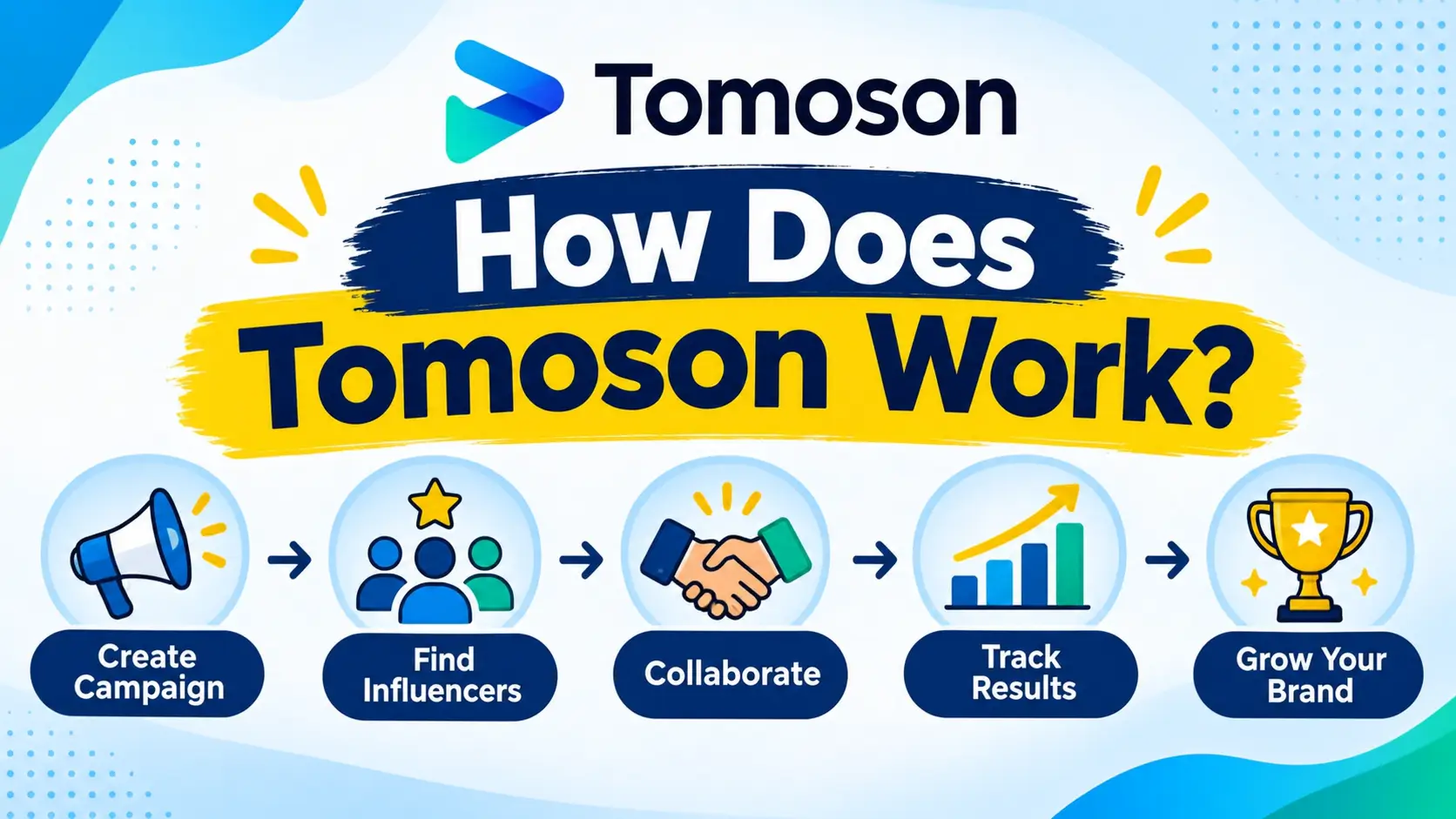
The general process followed several stages:
- A business prepared a promotional campaign.
- The campaign described the product and the required activities.
- Influencers discovered suitable opportunities and submitted applications.
- The business reviewed applicants and selected creators.
- Products or agreed promotional benefits were provided.
- Influencers tested the products and created original content.
- The completed work was submitted for verification.
- The business reviewed the deliverables and evaluated the campaign.
Each stage played a role in making the collaboration more organized.
Instead of relying entirely on informal conversations, the campaign structure provided a place to communicate expectations, identify participants, and monitor the completion of assigned activities.
The following sections explain these steps in more detail.
1. Businesses Create Promotional Campaigns
The process traditionally started when a business wanted to promote a product or service.
Before creating a campaign, the company needed to understand what it wanted to achieve. Some businesses wanted more product awareness, while others were interested in collecting detailed product feedback, generating blog content, or introducing a new product to a particular audience.
A campaign needed to communicate the opportunity clearly. This meant describing the product, explaining its purpose, identifying the preferred creator category, and outlining what participants were expected to complete.
For example, a company selling home organization accessories might create a campaign targeting bloggers who regularly publish interior design, home improvement, and lifestyle content.
A useful campaign description would explain:
- What product is being promoted.
- Who the intended audience is.
- Which type of influencer would be suitable.
- What content the creator is expected to produce.
- Whether the collaboration involves a free product, payment, or another arrangement.
- What the expected completion timeline is.
- Whether there are any specific campaign guidelines.
Clear requirements help businesses attract more relevant applicants.
A campaign that simply says a company wants more exposure does not provide enough information for a creator to understand the opportunity. On the other hand, a detailed description makes it easier for potential participants to decide whether the collaboration suits their interests and audience.
The original Tomoson model placed considerable importance on campaign requirements because brands could establish criteria for the types of influencers they wanted to work with.
This helped businesses avoid considering every applicant equally when their marketing goals required a specific audience or content category.
2. Influencers Discover Available Opportunities
After a campaign was published, interested influencers could explore promotional opportunities.
This was one of the main reasons the marketplace model appealed to bloggers and product reviewers. They did not necessarily need to spend hours searching for companies that might be interested in a collaboration.
Instead, they could look for campaigns connected to their content categories.
For example:
- A beauty blogger might look for skincare and cosmetics campaigns.
- A technology creator might prefer electronics and software-related opportunities.
- A food blogger might explore kitchen products and food-related promotions.
- A parenting blogger might consider products connected to children, family activities, or household needs.
- A fitness creator might be interested in exercise equipment and wellness products.
The goal was to find a collaboration that made sense for the creator’s existing audience.
This distinction matters because an influencer should not apply to every campaign simply because it offers an attractive product. A collaboration becomes more valuable when the creator can introduce the product naturally through content that their readers or followers already enjoy.
For instance, a technology blogger who regularly explains computer accessories may be a suitable partner for a keyboard manufacturer. The same blogger may not be the best choice for promoting a beauty product.
Relevance is more important than general popularity.
3. Influencers Submit Applications
After finding an interesting campaign, an influencer could apply according to its requirements.
The application process allowed businesses to assess potential participants before making a final selection.
An influencer’s profile and published content could help establish whether the creator was suitable for the opportunity.
Businesses were interested in factors such as:
- The creator’s main content category.
- The relevance of their audience.
- The quality of previously published content.
- Their website or social media presence.
- Their ability to produce the requested content.
- Their communication and reliability.
- Their available audience and engagement information.
The original platform’s influencer FAQ explains that brands could establish application requirements based on criteria such as audience figures and the subject of a creator’s blog. It also describes a manual selection stage in which brands chose the applicants they wanted to work with.
This approach helped companies consider more than follower numbers.
Imagine two creators applying for a campaign promoting an educational product. One has a large general entertainment audience, while the other has a smaller audience focused on education and learning.
The second creator might be more relevant even if their overall audience is smaller.
The purpose of reviewing applications was to identify people who could introduce the product to the right potential customers.
4. Businesses Review and Select Influencers
Once applications arrived, businesses could evaluate the creators and decide whom they wanted to approve.
This was a particularly important part of the original Tomoson process because the success of influencer marketing depends heavily on choosing suitable promotional partners.
A business should consider whether a creator’s audience is likely to have an interest in the product.
For example, a company selling premium kitchen equipment may prefer a cooking blogger who regularly publishes recipes and kitchen demonstrations. That creator can explain how the equipment works in a natural context.
Meanwhile, a company selling outdoor accessories might prefer hiking, travel, or camping creators.
The selection process should also include a closer examination of content quality.
A large follower count does not automatically demonstrate influence. Businesses should consider whether the creator publishes useful information, communicates consistently, and maintains meaningful audience interactions.
Some useful questions include:
- Does the creator regularly publish content in the relevant niche?
- Are the audience members likely to be interested in the product?
- Does the creator explain products honestly and clearly?
- Is the existing content consistent with the brand’s reputation?
- Can the creator complete the requested work within the agreed timeline?
- Are the collaboration expectations realistic?
The original Tomoson system allowed businesses to establish campaign requirements and manually approve applicants. This gave brands control over the people they selected.
However, final approval should not be based entirely on numerical statistics. A relevant and trustworthy creator can sometimes deliver a more useful collaboration than someone with a significantly larger but less relevant audience.
5. Products or Agreed Compensation Are Provided
After an influencer was approved, the next stage involved providing the product or compensation described in the campaign.
Tomoson’s historical model included product-based promotions in which businesses supplied products to creators for testing and reviewing.
Depending on the campaign, a product could be provided without charge or offered at a substantial discount. Some collaborations could also involve monetary compensation or other agreed benefits.
This is an important distinction because not every influencer campaign follows the same arrangement.
A product-testing campaign may provide an item in exchange for an honest review. A paid content campaign may involve a financial payment for creating an agreed video, article, or social media post.
Creators should understand exactly what they are receiving before accepting an opportunity.
For product-based collaborations, they should check:
- Whether the product is completely free.
- Whether shipping costs are included.
- Whether a purchase is required.
- Whether a discount code has an expiration date.
- Whether the campaign requires a particular content format.
- Whether payment is separate from the product.
- Whether any additional expenses are involved.
Businesses should also communicate clearly when providing products.
If an item is delayed, unavailable, or different from what was originally described, the creator should be informed. It is unreasonable to expect someone to complete a product review without receiving the product they agreed to test.
The original Tomoson influencer guidance emphasized reading campaign details carefully and communicating with businesses about shipment, coupon codes, and completion times.
That principle remains useful in any product collaboration, regardless of which platform a brand chooses.
6. Influencers Test Products and Create Original Content
Receiving a product does not automatically mean that an influencer has completed a campaign.
The creator must carry out the activity agreed upon with the brand.
In a traditional product-review collaboration, this means testing the item and developing an honest opinion based on its actual qualities and performance.
The content should provide value to readers rather than simply repeat the company’s product description.
For example, a blogger reviewing a kitchen appliance might discuss:
- The product’s appearance and construction.
- How simple it is to set up.
- Its main functions.
- Whether it performs the expected tasks.
- Its advantages and disadvantages.
- The type of customer who might benefit from it.
- Any limitations noticed during testing.
This approach creates more useful content than simply writing that the product is excellent.
Creators should also make sure the content is original.
Copying descriptions from the company’s website does not demonstrate genuine product experience. Readers are more likely to find a review helpful when it includes specific observations, practical explanations, and balanced opinions.
The type of content required depends on the campaign.
Possible formats include:
Blog posts: An influencer writes an article discussing the product, its features, and personal experience.
Product reviews: A creator evaluates an item and explains its strengths and weaknesses.
Social media posts: A participant introduces a product through a photograph, short video, or written update.
Tutorials: A creator demonstrates how to use a product or complete a particular task.
Unboxing content: An influencer shows the packaging, included accessories, and initial product experience.
Educational content: A blogger explains how a product fits into a wider topic or solves a common problem.
The objective is not simply to publish something mentioning a brand. It is to create content that communicates useful information while satisfying the agreed campaign requirements.
7. Completed Work Is Submitted for Verification
Once the content has been published or the required activity has been completed, the creator needs to provide evidence of completion.
Historically, Tomoson included a campaign-completion process in which brands could review submitted work.
Depending on the assignment, evidence might include a link to a published blog post, a social media post, or another agreed deliverable.
Businesses could then examine the submission and check whether it met the original requirements.
For example, a brand that requested a detailed product review would need to examine whether the submitted article actually discussed the product.
A valid submission should meet the agreed content format, publication requirements, and completion deadline.
The verification stage also helped identify incomplete or inappropriate submissions.
If a creator submitted an unrelated link, copied product information without genuine testing, or failed to deliver the requested content, the business could raise the issue.
Similarly, creators needed an opportunity to communicate problems when a company failed to provide the promised product or information.
A fair verification process should be based on the campaign agreement rather than whether the influencer expressed a positive opinion.
An honest negative or mixed review is not automatically an incomplete assignment. When a campaign asks for an independent product experience, the creator should be able to describe the product accurately.
8. Both Sides Evaluate the Collaboration
After the campaign was completed, both participants could assess whether the relationship was successful.
For a business, the evaluation might involve looking at content quality, audience engagement, website visits, referrals, and customer feedback.
For an influencer, the evaluation might involve considering whether the product was suitable, whether the business communicated professionally, and whether the opportunity was worth the time involved.
This final stage is important because one successful collaboration can create opportunities for future partnerships.
A business may discover that a particular creator communicates effectively with its target market. An influencer may also identify a company whose products are relevant to their audience.
However, a successful partnership should be based on mutual value rather than simply repeating promotional posts.
Businesses need to understand what a campaign actually achieved. Creators need to feel that their time and work were respected.
That is how a one-time promotion can become the beginning of a longer professional relationship.
How Does Tomoson Work for Businesses?
From a business perspective, Tomoson’s original purpose was to simplify influencer discovery and campaign management.
Traditional influencer outreach can involve considerable manual work. A marketing team may need to research creators, identify their contact information, send individual messages, negotiate campaign terms, arrange product delivery, and monitor published content.
A marketplace model attempts to bring several of these activities into a more organized process.
Businesses could prepare campaigns, establish participant requirements, review applicants, communicate with approved creators, and check completed tasks.
This was particularly relevant to smaller companies.
A business launching its first product might not have the resources to employ a full-time influencer marketing manager. A structured campaign marketplace could offer an alternative way to organize initial collaborations.
However, the platform could not make every marketing decision automatically.
Businesses still needed to determine their target audience, choose appropriate creators, prepare suitable products, establish realistic deadlines, and evaluate results.
A company should also distinguish between receiving promotional content and generating actual sales.
A blog post or social media mention may increase awareness without immediately producing purchases. Marketing outcomes depend on the product, audience, content quality, pricing, and many other factors.
Main Business Benefits
The historical Tomoson model offered several potential advantages for businesses.
Simplified creator discovery: Companies could explore potential influencers without starting every relationship through individual searches.
Campaign organization: Promotional requirements could be documented in a structured campaign.
Audience targeting: Businesses could specify the type of creator they wanted to attract.
Product feedback: Product-based campaigns offered opportunities to collect real experiences from people testing an item.
Content creation: Collaborations could result in blog posts, reviews, photographs, and social content.
Relationship development: Companies could identify creators who might be suitable for future promotional work.
Nevertheless, these benefits depended on a functioning service and successful collaboration management. A marketplace alone could not guarantee results.
How Does Tomoson Work for Influencers?
For influencers, the original marketplace model offered a way to discover brand opportunities without relying exclusively on direct outreach.
Content creators often spend considerable time developing their websites, social media profiles, and audience relationships. Finding suitable brands is another activity that can require significant effort.
Tomoson attempted to bring promotional opportunities into one place.
An influencer could explore campaigns, review the requirements, and apply when an offer matched their content niche.
For example, someone who publishes detailed technology reviews might look for opportunities involving headphones, computer accessories, mobile devices, or software.
A food blogger might focus on kitchen tools, cooking equipment, and food products.
The most important part of the process was selecting opportunities carefully.
Creators should not accept a campaign simply because it offers a product. They should consider whether their audience will find the content relevant and whether the collaboration is worth the time required.
What Influencers Needed to Consider
A professional creator should pay attention to several important factors before entering a promotional agreement.
Profile quality: A complete and accurate profile helps brands understand the creator’s content category and experience.
Audience relevance: A smaller but highly relevant audience may be more valuable than an unrelated larger audience.
Content quality: Previous articles, photographs, and videos provide examples of what the creator can produce.
Campaign requirements: Every deliverable should be understood before accepting an opportunity.
Product suitability: Creators should only promote products that make sense for their audience and content.
Deadlines: Product testing, writing, editing, and publication all take time.
Communication: Questions about shipment, payment, and requirements should be discussed before the creator commits.
Disclosure: Creators should make sponsored relationships, free products, and other material connections clear to their audience.
An influencer’s reputation is one of their most important professional assets. Accepting unsuitable collaborations can weaken audience trust, even when the product itself is provided without charge.
What Types of Campaigns Were Associated With Tomoson?
Tomoson’s historical campaign model was not limited to one product category.
Its public campaign information covered a broad range of industries. The general idea was to allow businesses to find creators who understood their products and could discuss them with relevant audiences.
1. Product Review Campaigns
Product review campaigns were central to the original Tomoson model.
A business provided an item for testing, and an approved creator produced a review based on the actual experience.
For example, a home appliance company might work with a blogger who regularly writes about household equipment.
A useful review would explain how the item works, discuss its practical benefits, and identify any limitations.
The business could receive informative product-related content, while the audience would gain another perspective on the item.
The review should remain honest, even when the experience is not entirely positive.
2. Social Media Promotion
Social media collaborations allow businesses to introduce products through platforms where creators already communicate with their audiences.
This might involve a photograph, a short demonstration, a product announcement, or a discussion of the creator’s experience.
The advantage of this format is that it can communicate product information in a visually engaging and accessible way.
Businesses can also strengthen their online presence through consistent communication and social media strategies for building brand visibility, audience engagement, and long-term recognition.
However, brands should not assume that a single social media post will produce immediate sales.
The result depends on whether the creator’s audience is interested in the product and whether the content provides a convincing reason to explore it.
3. Blog Content Campaigns
Blog campaigns allow creators to develop longer explanations than most short social media formats.
A blogger can discuss a product’s functions, explain how it compares with common alternatives, and describe situations in which it may be useful.
This is particularly helpful when a product requires explanation.
Understanding online publishing and content creation can also help businesses recognize how informative articles, product reviews, and educational content support their wider promotional strategies.
For example, software tools, educational products, home improvement equipment, and specialized accessories may benefit from detailed articles.
Blog posts can also remain accessible after their original publication date, giving readers another opportunity to discover the content.
However, businesses should not demand artificial backlinks, guaranteed rankings, or misleading recommendations as a condition of a supposedly independent review.
4. Unboxing and Demonstration Campaigns
Unboxing content focuses on the initial experience of receiving a product.
A creator might show its packaging, included accessories, design, and setup process.
Demonstration content goes further by showing how the product is used.
These formats can be useful for products whose appearance or operation is important to potential buyers.
A customer considering an electronic device, for example, may appreciate seeing its size, controls, and physical design before making a purchasing decision.
5. Product Launch Campaigns
Businesses introducing new products may use influencer collaborations to create awareness before or during a launch.
The content might introduce the product, explain its purpose, and demonstrate how it addresses a particular need.
A launch campaign should provide creators with accurate product information and enough time to understand what they are promoting.
It should also avoid making unrealistic promises about performance or availability.
Is Tomoson Free for Influencers?
Historically, Tomoson’s public influencer FAQ stated that joining as an influencer was free.
The model was designed to attract bloggers and creators who wanted to discover product collaborations without purchasing a brand subscription themselves.
However, free membership did not necessarily mean that every campaign involved receiving an entirely free product.
Some opportunities could involve discounted products, while others might include different compensation arrangements.
Creators needed to read the individual offer carefully.
It is particularly important to distinguish between three arrangements:
Free product collaboration: A creator receives the product without paying its purchase price and completes the agreed activity.
Discounted product collaboration: A creator receives a reduced price but may still need to pay for the item.
Paid collaboration: A creator receives monetary compensation for producing the agreed content or promotional activity.
These arrangements are not interchangeable.
Before accepting an offer, creators should calculate the actual cost of participation, including shipping, taxes where applicable, and the time required to produce the content.
They should also avoid assuming that a free product is sufficient compensation for a lengthy assignment.
A detailed tutorial, professional video, or long-form article can require substantial effort.
The compensation should reflect the work involved.
How Much Does Tomoson Cost?
Tomoson’s public pricing page continues to display monthly brand subscription options.
However, published pricing should not be confused with confirmation that a customer can currently activate and use the corresponding campaign software.
Historically, brands paid subscription fees to access campaign management features, while influencers could register without paying a membership fee.
The overall cost of an influencer campaign was also influenced by factors beyond the software subscription.
Businesses needed to consider the financial value of the products provided, shipping expenses, creator compensation, and the internal time required to manage collaborations.
For example, a company running a product-testing campaign might provide several items to approved creators. Even without a separate payment for every review, the business still carries product and shipping costs.
A paid video campaign creates another expense because the business needs to agree on a creator fee and any additional production requirements.
Costs Businesses Should Consider
When evaluating an influencer marketing opportunity, businesses should calculate:
- Platform subscription charges, where applicable.
- Product manufacturing or acquisition costs.
- Packaging and delivery expenses.
- Creator fees.
- Photography or video production expenses.
- Campaign management time.
- Content usage or licensing costs, if applicable.
- Additional marketing expenses connected with distribution.
This gives businesses a more realistic picture of the total campaign budget.
The cheapest collaboration is not necessarily the best option. A creator who produces relevant, useful content may deliver more value than several poorly matched promotional partners.
Likewise, companies should avoid paying for a subscription simply because a website displays attractive pricing. They should first verify that the advertised service is available, that the account can be activated, and that the payment terms are understandable.
How Can Businesses Measure the Success of an Influencer Campaign?
A campaign should have a clear purpose before it begins.
Without a defined objective, a business may struggle to decide whether the collaboration was successful.
Some companies want to introduce a new product to potential customers. Others want to generate website visits, collect product feedback, produce marketing content, or increase sales.
Each objective requires a different evaluation approach.
Understanding digital marketing campaign performance is important because businesses need to evaluate whether their promotional activities are generating meaningful results rather than simply attracting attention.
Influencer promotions can also work alongside SEO and digital marketing strategies, helping businesses develop a broader approach to online visibility and audience discovery
Brand Awareness
When the goal is awareness, businesses should examine how effectively the campaign introduces the product to the intended audience.
Useful indicators may include:
- Content views.
- Audience reach.
- Social media mentions.
- Brand-related searches.
- Comments and discussions.
- Content shares.
These indicators help establish whether people are encountering the brand.
However, a high number of views does not automatically demonstrate purchase interest.
Website Traffic
Businesses can examine whether a creator’s content sends visitors to a product or landing page.
Trackable links and campaign-specific landing pages can help identify the traffic associated with individual collaborations.
Companies should pay attention to more than visitor numbers.
They should also examine whether visitors explore product information, spend time on the website, or complete useful actions.
Engagement
Engagement helps businesses understand how people respond to a creator’s content.
Comments, relevant questions, saves, shares, and meaningful conversations can provide useful context.
A post that generates thoughtful product questions may be more valuable than one that receives a large number of unrelated reactions.
Sales and Conversions
When a business wants to generate purchases, it should measure conversions.
A campaign-specific discount code or a properly configured tracking link may help connect a purchase with a promotional activity.
Businesses should also consider other factors that may influence buying decisions.
A customer could discover a product through an influencer, research it independently, and purchase it several days later.
Therefore, campaign performance should be evaluated using a reasonable measurement framework rather than relying on one number.
Customer Feedback
Product campaigns may also help companies identify how people experience their products.
Creators might discover usability problems, confusing instructions, missing accessories, or product features that customers particularly appreciate.
Businesses can use these observations to improve product descriptions, packaging, instructions, and future marketing materials.
Advantages of Tomoson’s Original Influencer Marketing Model
Tomoson’s original approach offered several potential advantages to businesses and creators.
A More Organized Outreach Process
Finding individual creators can be time-consuming.
A marketplace makes the discovery process more structured by presenting promotional opportunities and applications in a common environment.
This can reduce the administrative burden associated with initial outreach.
Opportunities for Smaller Businesses
A business does not necessarily need a large advertising budget to experiment with creator collaborations.
Product-based campaigns may offer a starting point for companies that want to explore influencer marketing.
However, businesses must still account for the cost of products, delivery, management, and any compensation.
Access to Different Content Categories
A marketplace that serves multiple industries can help businesses identify creators working in different niches.
This can be useful for companies whose products appeal to more than one audience.
Opportunities for New Influencers
Creators who are still developing their portfolios may benefit from discovering brands and promotional opportunities.
A relevant collaboration can provide practical experience and help them understand professional campaign requirements.
More Structured Campaign Communication
A centralized process can make it easier to discuss requirements, delivery problems, and completion status.
This helps reduce misunderstandings between businesses and creators.
Potential for Long-Term Relationships
When a collaboration is successful, both parties may have a reason to work together again.
The relationship can develop beyond an individual product review into a more consistent brand partnership.
Limitations and Disadvantages of Tomoson
Although the original marketplace model had useful features, it also involved limitations that users should consider.
Campaign Quality Could Vary
Not every campaign is necessarily suitable for every creator.
A marketplace can contain opportunities that differ significantly in quality, relevance, compensation, and expectations.
Creators need to review offers carefully rather than assuming every listing represents a valuable opportunity.
Product-Only Compensation May Not Be Enough
Some businesses may expect significant work in exchange for a product.
However, producing a detailed article, professional video, or tutorial requires time and skill.
Influencers should assess whether the offered benefit fairly reflects the assignment.
A Large Audience Does Not Guarantee Results
Even when a creator has a substantial audience, promotional performance depends on relevance and audience interest.
Businesses should examine the quality of a potential partnership rather than focusing exclusively on follower numbers.
Quality Control Remains Important
A platform can organize the collaboration, but it cannot automatically guarantee excellent content.
Businesses still need to evaluate creators, communicate expectations, and check submissions.
Likewise, creators need to assess the reputation and professionalism of participating brands.
Platform Availability Is a Major Consideration
One of the most important limitations today is uncertainty about the availability of Tomoson’s original marketplace.
Its public website contains information describing historic campaign activities, but its current presentation also identifies it as a digital information resource.
Consequently, readers should not assume that old campaign instructions, listed membership options, or promotional opportunities are currently operational.
Before sharing personal details, submitting applications, accepting an offer, or entering payment information, users should verify that the relevant service actually works and that its terms are current.
This issue is especially important for brands that need a dependable system for managing active marketing campaigns.
Is Tomoson Still Active in 2026?
This is one of the most important questions for anyone researching Tomoson today.
As of November 21, 2026, Tomoson’s website remains accessible and contains several pages associated with its earlier influencer marketing model. These include campaign information, brand FAQs, influencer FAQs, and subscription pricing.
However, an accessible webpage does not necessarily mean that the original marketplace is operating normally.
The website’s current About page describes Tomoson as a resource for digital learning and articles about topics such as influencer marketing, social media, and personal branding. At the same time, other pages continue to display older marketplace information.
This creates an important distinction between the website’s published information and the practical availability of its original services.
Independent checks have also reported problems with campaign and login links, including redirects rather than access to a functional marketplace.
For this reason, it would be misleading to tell readers that they can definitely create a new account, apply for campaigns, or hire influencers through Tomoson today.
The safest interpretation is that Tomoson has a recognizable history as an influencer marketing marketplace, but its original campaign functionality should be treated as unverified unless the company confirms otherwise.
What Should Potential Users Do?
Before attempting to use the service, take a few practical precautions:
- Visit the official Tomoson website and review its current About and Contact pages.
- Check whether the registration process opens a genuine account creation form.
- Verify that the login page provides access to a functioning dashboard.
- Confirm that campaign listings contain current opportunities rather than old or inactive entries.
- Review the latest subscription terms and refund conditions.
- Contact the company to confirm whether new brands and influencers are being accepted.
- Avoid submitting payment information until the advertised service and its contractual terms have been verified.
These steps can help prevent confusion between historical platform information and services that are genuinely available.
Practical Tips for Brands Considering Tomoson
Businesses researching Tomoson should approach it as part of a broader evaluation of influencer marketing options.
The first priority is verifying operational availability. If the original marketplace cannot be accessed, the business should not build an active marketing schedule around it.
However, the principles behind its original system remain useful for organizing creator collaborations elsewhere.
Establish a Clear Marketing Objective
Decide what the campaign should achieve.
Is the purpose to introduce a product, create educational content, collect feedback, increase website traffic, or generate sales?
A clear objective helps determine which creators and content formats are appropriate.
Identify the Right Audience
Before searching for creators, understand the people most likely to be interested in the product.
Consider their interests, common questions, purchasing habits, and the type of content they regularly consume.
This helps narrow the search to creators who can introduce the product naturally.
Examine Content Quality
Look beyond follower numbers.
Read previous blog posts, watch published videos, and examine how creators discuss products.
A good promotional partner should be able to explain the product clearly without relying entirely on the brand’s own marketing language.
Prepare a Useful Campaign Brief
A campaign brief should explain what the business wants, what it is offering, and what participants must deliver.
It should also explain deadlines, content formats, disclosure requirements, and any restrictions.
Allow Honest Opinions
Businesses should never require creators to publish positive opinions in exchange for products or payment.
A campaign should focus on genuine experience, accurate information, and appropriate disclosures.
Honest feedback may also reveal opportunities to improve the product.
Review Results Carefully
Track performance against the original objective.
A campaign intended to produce product awareness should not be judged exclusively on immediate sales.
Similarly, a campaign designed to generate purchases should not be considered successful simply because it received a large number of views.
Practical Tips for Influencers Interested in Product Campaigns
Creators should be equally careful when evaluating promotional opportunities.
A free product may appear attractive, but the real value of an offer depends on the work required and the relevance of the collaboration.
Maintain a Professional Online Profile
A creator’s public profile should explain their content niche and demonstrate the quality of their work.
Businesses need to understand what type of audience the creator reaches and what kind of content they can produce.
Apply to Relevant Campaigns
Focus on products that connect naturally with the subjects already discussed.
A relevant collaboration is generally easier to explain and more useful to an existing audience.
Review Requirements Before Applying
Check whether the campaign requires an article, video, social post, or another deliverable.
Understand the expected publication date, payment arrangement, and product delivery conditions.
Keep Communication Professional
Respond to messages clearly and discuss problems promptly.
If shipping is delayed or the product arrives damaged, communicate the issue before the deadline passes.
Create Original Content
Use your actual experience rather than reproducing company descriptions.
Describe what you tested, explain your observations, and make clear which features worked well and which could be improved.
Protect Your Reputation
Avoid promoting products you have not genuinely assessed.
Be transparent about free products, sponsorships, and payment relationships.
A creator’s long-term credibility is more valuable than any single promotional opportunity.
Case Study 1: How a Small Skincare Brand Could Use the Tomoson Model
The following is an illustrative example, not a verified historical Tomoson campaign.
Imagine a small skincare company that has developed a moisturizer designed for people who prefer simple daily skincare routines.
The business has a limited marketing budget and wants to introduce the product to an audience interested in skincare.
Instead of immediately investing in a large advertising campaign, it considers a creator-based product promotion.
Step 1: Define the Target Audience
The business identifies its ideal customers as people interested in skincare routines, moisturizing products, and practical beauty advice.
It decides that skincare bloggers and beauty creators would be more relevant than general entertainment personalities.
Step 2: Prepare the Campaign
The company prepares a campaign description explaining the product, its ingredients, intended use, and the type of content requested.
It makes clear that creators should test the product and provide an honest assessment.
Step 3: Select Suitable Creators
The business reviews potential participants.
Rather than automatically choosing the creators with the largest audiences, it looks for people who publish relevant skincare content and communicate effectively with their readers.
Two suitable bloggers are selected for the hypothetical campaign.
Step 4: Deliver the Products
The company arranges product delivery and provides the information needed to use the moisturizer correctly.
The creators receive sufficient time to try the item as part of their normal routines.
Step 5: Publish Honest Reviews
Each creator publishes an original review discussing the product’s texture, packaging, application experience, and suitability for their preferences.
One creator particularly appreciates the lightweight texture, while the other feels that the moisturizer may not be ideal for their personal skin preferences.
Both reviews offer useful information because they describe genuine experiences.
Step 6: Evaluate the Campaign
The business examines the published content, comments, referral activity, and customer feedback.
It also looks for recurring questions about product use.
The company discovers that readers want clearer explanations about application and product suitability.
It uses those observations to improve its product information page.
What This Case Study Demonstrates
The example shows how a product-based influencer campaign can offer more than promotional exposure.
A well-managed collaboration can produce original content, audience discussions, customer questions, and practical product feedback.
However, the example does not demonstrate guaranteed sales or a specific return on investment. Actual results would depend on product quality, creator relevance, audience interest, and the quality of campaign execution.
Case Study 2: How a Technology Startup Could Organize Creator Collaborations
This is another hypothetical example intended to demonstrate the campaign process.
Imagine a small technology company introducing a wireless accessory for people who regularly work from home.
The company wants to explain how the product functions and help potential customers understand its practical uses.
Traditional advertisements might introduce the item, but the business believes that demonstrations and detailed explanations would be more useful.
Step 1: Identify the Right Creators
The company looks for technology bloggers, home-office creators, and reviewers who regularly discuss accessories.
It prioritizes relevant content experience over general popularity.
Step 2: Create a Demonstration Brief
The company explains what the product does, how it should be tested, and which aspects are important to demonstrate.
Creators are encouraged to discuss both advantages and limitations.
Step 3: Provide Products for Testing
Approved creators receive the accessory and the information necessary to set it up.
They are given reasonable time to use the product before preparing their content.
Step 4: Produce Different Content Formats
One creator prepares a detailed written review.
Another creates a short demonstration showing the setup process and practical use.
A third prepares an educational post discussing how the accessory may fit into a home-office environment.
Step 5: Measure Audience Response
The company evaluates content quality, comments, website visits, and product-related questions.
It discovers that potential customers are particularly interested in compatibility and installation.
The business improves its product documentation to address those concerns.
What This Case Study Demonstrates
Different content formats can help explain different aspects of a product.
A written review may provide detailed information, while a video demonstration can make setup and operation easier to understand.
The company gains useful customer insights even if every viewer does not become an immediate buyer.
The main lesson is that influencer marketing works best when the chosen content format matches the questions potential customers actually have.
What Are the Alternatives if Tomoson Is Not Available?
People researching how Tomoson works may also be looking for ways to arrange product reviews or creator collaborations today.
If the original marketplace cannot be accessed, there is no reason for a business or influencer to stop exploring influencer marketing altogether.
Several categories of services can support similar objectives.
Influencer Marketing Marketplaces
These services connect brands with creators who are interested in promotional opportunities.
Depending on the provider, businesses may be able to publish campaigns, search creator profiles, review applications, and manage partnerships.
Influencer Relationship Management Software
These systems focus on helping businesses organize their existing creator relationships.
They may include contact management, campaign tracking, communication tools, and reporting features.
They are particularly useful for companies that work with multiple creators over an extended period.
Product Sampling Communities
Some services focus on distributing products to people who are interested in testing and discussing them.
Businesses should examine the terms carefully to understand whether the service provides product feedback, public content, or another form of collaboration.
Direct Influencer Outreach
Companies can also contact suitable creators independently.
This approach requires more research and administrative work, but it gives businesses greater control over selecting partners and negotiating campaign requirements.
A company can identify relevant bloggers, review their previous work, and contact them with a personalized proposal.
User-Generated Content Platforms
Businesses that mainly want photographs, videos, tutorials, and other creative assets may prefer services specializing in user-generated content.
These services may be more suitable when the primary objective is to obtain reusable creative material rather than reach a creator’s existing audience.
How to Choose an Alternative
Before selecting another platform, consider:
- Whether the service is actively operating.
- Which social networks and content formats it supports.
- Whether it allows both brands and creators to participate.
- How its pricing structure works.
- Whether campaign payments are protected.
- What reporting and analytics are available.
- What rights the business receives to reuse creator content.
- Whether the platform provides appropriate communication and support.
The best alternative depends on the actual marketing objective rather than the similarity of its name or appearance to Tomoson.
Is Tomoson Worth Considering for Influencer Marketing?
The answer depends on what someone expects from the platform.
Historically, Tomoson’s marketplace model offered a practical way for businesses and creators to find one another through product-based campaigns and promotional opportunities.
For businesses, the main attraction was the ability to organize influencer outreach, review applications, and collect content through a structured process.
For creators, the model offered a way to discover collaborations and find products that could be relevant to their existing content.
Those ideas remain useful in modern influencer marketing.
However, the availability issue changes the practical recommendation.
A business looking for an active campaign management system should not select Tomoson solely because its website displays subscription plans or describes historical campaign features.
It should first establish whether the original software is operating and accepting new users.
Similarly, influencers should not spend time preparing applications for opportunities that cannot be verified.
The platform’s historical approach can be useful to understand, but users should base present-day decisions on the actual services they can access.
Common Mistakes to Avoid When Using Influencer Marketing Platforms
Whether someone is researching Tomoson or another marketplace, several mistakes can reduce the effectiveness of creator collaborations.
Choosing Influencers Only by Follower Count
A creator may have a large audience without reaching people interested in the promoted product.
Audience relevance and content quality should be considered alongside reach.
Ignoring Campaign Requirements
Accepting an opportunity without understanding its deliverables can lead to disagreements.
Both parties should understand the work before making a commitment.
Expecting Every Product Review to Be Positive
Independent product feedback cannot be guaranteed to be favorable.
Businesses should value accuracy and transparency instead of attempting to control the creator’s opinion.
Forgetting the Cost of Time
A product may be free, but testing and producing content still requires work.
Creators should evaluate the assignment realistically.
Failing to Measure the Results
Without agreed performance indicators, businesses may struggle to identify what a campaign achieved.
Establish the evaluation method before the collaboration begins.
Assuming a Platform Is Operational Because Its Website Is Online
This is especially relevant when researching older services.
A website can continue displaying pricing information and campaign listings even when some of its underlying functionality is no longer available.
Always verify the actual service before committing money or personal information.
Final Thoughts on How Does Tomoson Work
Understanding how Tomoson works requires looking at its original purpose as well as its present availability.
Historically, Tomoson connected businesses with bloggers and influencers through promotional campaigns. Companies could describe products, establish campaign requirements, review interested creators, and organize product-based collaborations. Influencers could discover opportunities, test suitable products, and create original content in exchange for agreed benefits.
This model made influencer marketing more organized by bringing campaign discovery, applications, communication, and completion tracking into a common process.
Its underlying principles remain relevant today. Successful creator partnerships still depend on audience relevance, clear expectations, honest content, professional communication, and meaningful performance measurement.
However, the current status of Tomoson’s original marketplace should be treated cautiously. Public information about its historical features does not establish that its campaign system is accepting new users or operating normally in 2026.
Anyone considering the platform should verify its registration, campaign, account, and payment functionality before proceeding.
Ultimately, the most important lesson is that influencer marketing is not simply about finding someone with followers. It is about developing a relevant partnership in which a business receives meaningful communication with potential customers and a creator produces useful, honest content for an audience that trusts them.
Frequently Asked Questions (FAQs)
1. How does Tomoson work?
Tomoson historically worked as an influencer marketing marketplace. Businesses created promotional campaigns and described their products, requirements, and preferred creator types. Influencers could discover relevant opportunities, submit applications, and receive approval from brands. Approved participants received products or agreed compensation and completed the required promotional activities. The business could then review the submitted content and evaluate the collaboration.
2. What is Tomoson used for?
Tomoson was historically used for influencer outreach, blogger collaborations, product testing, promotional campaigns, and content creation. Businesses used its marketplace model to connect with creators who could introduce products to relevant audiences. Influencers and bloggers could use it to discover brand opportunities and participate in product-based promotions.
3. Is Tomoson free for influencers?
According to Tomoson’s historical public influencer FAQ, influencer registration was free. However, individual campaigns could involve different arrangements, including free products, discounted products, or paid work. Creators should always check the actual terms of an offer rather than assuming every opportunity provides an entirely free product.
4. Do businesses have to pay to use Tomoson?
Tomoson’s public pricing page displays monthly subscription plans for businesses. Historically, companies paid subscription fees for access to marketplace features, while creators could register without a membership fee. However, the presence of published prices does not confirm that the original software is currently available. Businesses should verify the service and current billing terms before subscribing.
5. How do influencers get selected on Tomoson?
Historically, brands established campaign requirements and reviewed applications from interested influencers. Selection could involve considering the creator’s niche, audience figures, published content, and suitability for the campaign. The business had the opportunity to make the final selection rather than automatically approving every applicant.
6. Are products on Tomoson completely free?
Not necessarily. Tomoson’s historical influencer FAQ explained that most products were provided without charge, while some opportunities involved heavily discounted products. The campaign description explained the relevant arrangement. Influencers needed to read the requirements carefully to understand whether they had to purchase anything or pay shipping costs.
7. Can influencers earn money through Tomoson?
The historical marketplace model supported different types of promotional collaborations, and compensation depended on the individual campaign. Some opportunities focused on products, while others could involve paid promotional work. Creators should distinguish between receiving a free product and receiving monetary payment because they are not the same benefit.
8. Does Tomoson guarantee influencer marketing results?
No. A marketplace cannot guarantee that a collaboration will produce a particular number of sales, views, customers, or website visits. Results depend on product quality, audience relevance, content quality, campaign planning, and other marketing factors. Businesses should establish realistic objectives and measure actual performance.
9. What types of products can be promoted through Tomoson?
Historically, the platform supported a wide range of product categories. Examples included beauty products, clothing, food, technology accessories, home and garden items, fitness products, books, and other consumer goods. The appropriate creator depended on the campaign and the intended audience.
10. Is Tomoson still working in 2026?
Tomoson’s website remains accessible, but its current marketplace availability is uncertain. It still displays historical campaign information, pricing, and FAQs, while its current About page presents the website as a source of digital information. Independent reports have also identified problems with campaign and account links. Therefore, users should verify whether registration and campaign functionality actually work before relying on the service.
11. Can beginners use Tomoson?
Historically, the marketplace model could be useful for beginners because it gave bloggers and creators a way to discover promotional opportunities. However, beginners still needed a relevant content profile, suitable audience, and ability to complete campaign requirements. Today, they should also confirm that the service is operational before investing time in registration or applications.
12. What should a blogger check before accepting a Tomoson campaign?
A blogger should examine the product, campaign requirements, compensation, shipping arrangements, publication deadline, and content format. They should also understand disclosure requirements and confirm that the collaboration allows an honest opinion. Checking these details beforehand can prevent disagreements and protect the creator’s professional reputation.
13. Is Tomoson suitable for small businesses?
Its original campaign model was designed to make influencer collaboration more accessible to businesses of different sizes. Smaller companies could explore product-based promotions without necessarily hiring a large marketing agency. However, whether Tomoson itself is a suitable option today depends on whether its original marketplace functionality can be verified.
14. What are the best alternatives to Tomoson?
The best alternative depends on the goal. Influencer marketplaces are useful for discovering creators, relationship management software helps businesses organize partnerships, product sampling communities focus on testing opportunities, and user-generated content services help companies obtain creative assets. Direct outreach is another option for businesses that prefer to select and contact creators independently.
15. Why is influencer marketing useful for businesses?
Influencer marketing gives businesses an opportunity to communicate with audiences through creators who already publish relevant content. A suitable collaboration can introduce a product, explain its practical uses, generate customer discussions, and provide original promotional material. Its effectiveness depends on the relevance and quality of the partnership rather than simply the size of the creator’s audience.
16. Can a product review on Tomoson be negative?
The historical purpose of product-review campaigns was to encourage creators to provide honest feedback based on their product experience. A review should not be considered invalid simply because it identifies disadvantages. Accurate and transparent feedback is more useful to customers and businesses than a positive opinion that has been artificially required.
17. How can businesses know whether an influencer campaign was successful?
Businesses should measure performance against the campaign’s original purpose. Depending on the objective, useful indicators can include relevant audience engagement, website referrals, conversions, product feedback, and content quality. Reviewing multiple indicators gives a more realistic understanding of campaign performance than relying on follower numbers alone.
18. Should businesses still rely on Tomoson’s old pricing information?
Businesses should be cautious about relying on historical or publicly displayed pricing without confirming that the service is operational. A published subscription plan does not prove that the corresponding software features are available. Companies should verify the registration process, current terms, payment arrangements, and customer support before making any financial commitment.
For More Visits: Bright Magazine
