

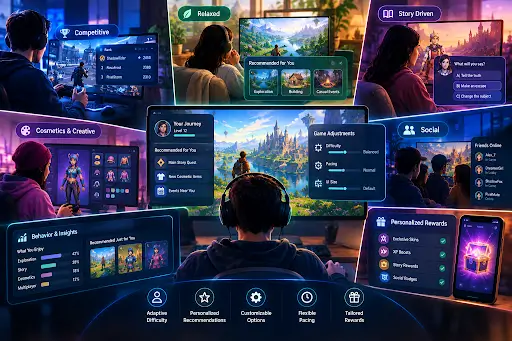
Every player is different. Someone seeking intense competitive challenge wants nothing to do with a relaxing experience. A player with limited time needs systems that respect that constraint. A player motivated by cosmetics doesn’t care about competitive rankings. Yet most online games treat all players identically, offering the same difficulty, the same progression pace, the same rewards regardless of what each individual player actually wants. That one-size-fits-all approach works for no one perfectly and frustrates everyone partially. Personalization changes this by recognizing that player preferences vary dramatically and automatically adjusting the experience to match what each individual player actually needs. That customization transforms games from products that work okay for everyone into experiences that feel specifically designed for whoever is playing.
Why Personalization Matters Now
Player expectations have shifted. In other digital services, personalization is standard. Music platforms recommend songs based on listening history. Video services suggest content based on viewing patterns. Shopping sites show products matching browsing behavior. Players increasingly expect games to work similarly, recognizing their preferences and adjusting accordingly. Games that don’t personalize feel outdated by comparison to alternatives that do.
That expectation also reflects genuine value. A player who gets recommendations matching their interests engages more than one seeing random suggestions. A player with difficulty tuned to their skill level stays engaged longer than one fighting inappropriate challenge. A player getting rewards matching their motivation remains loyal better than one seeing rewards they don’t care about. Personalization creates better experiences for individual players, which directly impacts retention and satisfaction.
Understanding What Players Actually Want
Track Behavior, Not Surveys
Players often can’t articulate what they actually want. Surveys about preferences capture stated preferences, but actual behavior reveals real preferences. A player might say they want challenging content but consistently avoids difficult encounters. Another might claim they want cosmetics but rarely engages with customization options. That disconnect between what people say and what they do makes behavioral observation far more reliable than direct questions.
That observation should be unobtrusive. Players shouldn’t feel spied on, they should experience systems responding to their natural behavior. The system notes what they engage with, what they ignore, what they return to repeatedly, and uses that observation to adjust what gets emphasized.
Identify Different Player Types
Not every player can be categorized the same way. Some players fit clear archetypes: the competitor seeking ranking challenges, the completionist wanting every achievement, the explorer wanting hidden content, the social player seeking connection. Others don’t fit neatly into categories. That variety means personalization needs to be nuanced rather than forcing players into predefined boxes.
Sophisticated personalization recognizes spectrum rather than categories. A player isn’t purely competitive or purely casual, they’re somewhere on a spectrum that shifts based on mood, available time, current interests. Personalization adapts to that spectrum rather than forcing binary categorization.
Observe What Creates Engagement
Different things create engagement for different players. A challenging boss creates excitement for one player and frustration for another. A cosmetic reward matters to some and feels meaningless to others. A social feature invites one player to community and exhausts another. Understanding what specifically creates engagement for individual players, not what generically creates engagement, drives effective personalization.
That understanding comes from observation. Which features does a player spend time with? Which do they ignore? What gameplay moments generate replay? What progression systems motivate continued play? Those observations reveal what actually engages each individual rather than relying on assumptions.
Implementing Personalized Experiences
Adaptive Difficulty That Respects Skill
Dynamic difficulty that monitors performance and adjusts challenge appropriately is perhaps the most impactful personalization. A player dominating enemies should face harder challenges. A player struggling should get slightly easier encounters. That constant calibration keeps players in the engagement zone where challenge feels just right.
That adaptation should be transparent. Players should understand that difficulty is adjusting based on their performance, not that the game is arbitrarily getting easier or harder. That transparency builds trust that the system is personalizing in their favor rather than manipulating them.
Content Recommendations Based on Behavior
Rather than showing the same content to all players, personalization recommends what individual players actually care about. A player who consistently pursues cosmetics sees cosmetic recommendations first. A player engaging heavily with story gets story content highlighted. A player competing on leaderboards sees competitive opportunities. That curation means players discover content matching their interests rather than wading through recommendations irrelevant to them.
Those recommendations should include occasional surprises, new content slightly different from typical preferences. That variety prevents recommendation systems from creating echo chambers where players only ever see what they already like. A player might discover a new interest when exposed to adjacent content their behavior patterns didn’t fully predict.
Customizable Gameplay Options
Some personalization comes from giving players direct control. Difficulty sliders. Accessibility options. UI customization. Control scheme alternatives. Those options let players personalize their experience themselves, choosing how the game adapts to their needs. That agency means players feel like the game respects their preferences rather than having preferences imposed on them.
Pacing That Matches Time Investment
Players have different amounts of time available. Some play for hours, others in brief sessions. Personalization accommodates that variety through flexible progression. A player with thirty minutes should experience meaningful advancement. A player with three hours should have enough content for extended sessions. That flexibility means progression feels natural regardless of available time.
Reward Personalization Based on Motivation
Different players respond to different rewards. A cosmetic collector wants appearance options. A competitive player wants ranking recognition. A narrative player wants story progression. A social player wants community recognition. Personalizing which rewards get emphasized means each player experiences motivation matching their actual goals rather than generic rewards that matter equally to no one.
A Practical Example of Personalization Working Well
Steal an Egg demonstrates what thoughtful personalization produces, a game that recognizes different player motivations and delivers experiences matching individual preferences. The game shows how understanding player behavior and adjusting accordingly creates engagement that one-size-fits-all design never achieves.
Understanding how to create online games with personalized player experiences means shifting from designing for the average player to designing systems that recognize and accommodate individual difference.
Testing Personalization Features
Observe Engagement Patterns
The real test of personalization is whether it increases engagement. A personalization feature that doesn’t change engagement metrics isn’t working. A feature that clearly correlates with increased playtime, longer retention, or higher satisfaction is working effectively. Actual engagement data reveals whether personalization is actually improving experience.
Gather Player Feedback About Fit
Ask players whether the game feels like it understands their preferences. A player should feel like difficulty is appropriate for them specifically. A player should feel like recommendations match their interests. A player should feel like rewards matter to their specific motivations. That alignment means personalization is working.
Identify Segments That Aren’t Well Served
Some player types might not be well-accommodated by personalization systems. A player type that doesn’t fit standard categories might find recommendations don’t match their actual interests. A player with unusual motivations might find rewards don’t reflect what they care about. Identifying those unserved segments lets you expand personalization to accommodate them.
Final Thoughts
Online games personalizing player experience means tracking behavior to understand actual preferences, offering adaptive difficulty and content recommendations matching individual interests, providing customization options giving direct control, and emphasizing rewards matching what each player actually cares about. Test whether personalization actually improves engagement, gather feedback about whether systems feel appropriately tailored, and expand to accommodate underserved player segments. The result is games where players feel understood, where experiences feel specifically designed for them, where progression and rewards matter personally. That recognition transforms games from products into personalized experiences.
