

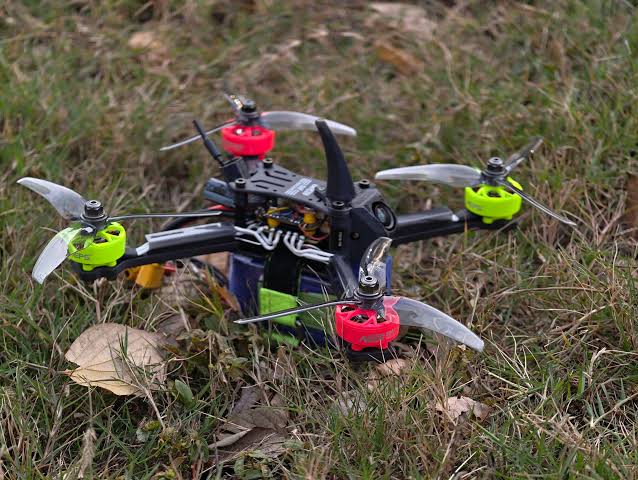
There’s a category of FPV motor that exists purely to be replaced: the $30 flagship that makes beautiful thrust numbers and then eats a bell on its second bando session, and the $9 clone that arrives with 80mΩ of winding resistance and a bearing that sounds like gravel by pack ten. The interesting motor is the one in between — cheap enough to treat as a consumable, built well enough that you don’t have to.
The MEPS Neon 2207 V2 is aimed squarely at that gap, and after a season of flying the V1, the V2’s spec sheet reads like a list of the V1’s complaints answered one by one. This is what changed, what it feels like in the air, and who should actually buy it.
The numbers that moved
All figures below are from MEPS’s published bench data at 2050KV on SZ5145 5-inch tri-blades — the same prop, same conditions, V1 vs V2:
| Metric | Neon 2207 (V1) | Neon 2207 V2 | What it means |
| Peak thrust | 1,690g | 1,836g | +8.6% usable punch on dives and recoveries |
| Max power | 1,245W | 1,197W | More thrust from less power |
| Internal resistance | 64mΩ | 56mΩ | Faster throttle response, less heat |
| Idle current @10V | ≤2.0A | ≤1.65A | ~17% less waste at cruise |
| Peak current | 53.5A | 49.0A | Kinder to a 45–50A ESC |
That last line is the one I care about most. Going up 146g of thrust while going down 4.5A of peak current is not a marketing trick — it’s what a lower-resistance winding buys you. It means a 45A 4-in-1 is no longer marginal, and it means less sag at the end of a pack.
What 56mΩ feels like
Resistance is the most under-reported spec in the hobby because it’s the one you can’t fake. Lower resistance means the motor converts a higher fraction of what your battery sends into rotation instead of heat, and the practical effect is throttle linearity.
On the V1, mid-stick had a slightly vague zone — you’d add 5% and get nothing, then 5% more and get a jump. The V2’s low end is noticeably tighter. In practice that shows up as:
- Cleaner slow-speed proximity lines, because small corrections actually move the quad by the amount you asked for
- Less prop-wash oscillation on hard reversals (split-S, power loops) — the motor recovers RPM faster because there’s less electrical lag
- Cooler bells after a hard pack, which matters more than any spec once you’re flying back-to-back batteries
I flew the 1950KV on 6S with a DJI Action 2 strapped on, which is the worst case for jello and prop wash. Straight-line footage was clean; turnarounds showed the usual tiny bit of shake that any 5-inch shows, but no ringing.
The durability question, which is the real question
A $17 motor lives or dies on crashes, not thrust. The V2’s changes here are structural rather than electrical:
- Reinforced ratchet top and thicker bell walls — the bell resists deformation at the bearing seat, which is where cheap motors die. Once the seat is out of round, the shaft is never true again and the motor howls.
- 6082 aluminum bell, stainless shaft, NMB bearings, N50H magnets. These are the right parts. NMB bearings are the difference between a motor that’s smooth in month six and one that’s gritty in week three.
- ~2g weight penalty per motor. That’s the honest cost of the reinforcement: 8g across the quad, maybe 0.5% of AUW. I’ll take it.
One field detail worth calling out: the standard 3-pin lead layout is MR30-compatible. On a quad already running MR30 motor plugs, a dead motor is a 60-second swap with no soldering iron, no stack disassembly, and no risk of a cold joint at the field.
KV selection, without the guesswork
| KV | Voltage | Fly it if |
| 1950KV | 6S | All-round freestyle, cinematic bandos. Smoothest low end, lowest current spikes, longest flight time. The default. |
| 2050KV | 6S | Aggressive freestyle and racing. More top-end pop, faster recovery out of blind drops. |
| 2550KV | 4S | Legacy 4S builds and high-RPM acro. Don’t put this on 6S. |
Pair it with a 45–60A 4-in-1 (DShot300/600), 5-inch tri-blades in the 5145–5146 range, and a 1,300–1,600mAh 6S pack.
Where it doesn’t win
Two honest caveats. First, if you race at a level where 3g of rotating mass decides a lap, this isn’t your motor — a lighter, more expensive 2207 will beat it. Second, the pricing is promotional and moves; the list price sits around $17 with frequent sale pricing well under it, so don’t build a budget around a flash-sale number that expires.
Also: buy five, not four. Motors fail one at a time, and the fifth motor in the field kit is the cheapest insurance in the hobby.
Verdict
The Neon 2207 V2 is the motor I’d hand to someone building their second 5-inch — the one who’s tired of replacing $12 motors every month but isn’t ready to spend $120 on a set. It fixes the V1’s two real weaknesses (bell durability and mid-throttle vagueness) without adding cost or current draw, and it does it with parts — 6082 bell, NMB bearings, N50H magnets — that shouldn’t be in this price bracket.
Rating: 4.5/5. Half a point off for the 2g it gained getting tougher, which is a complaint I’ll happily make.
Disclosure: review sample supplied by the manufacturer. Bench figures are the manufacturer’s published data; flight impressions are my own.
