

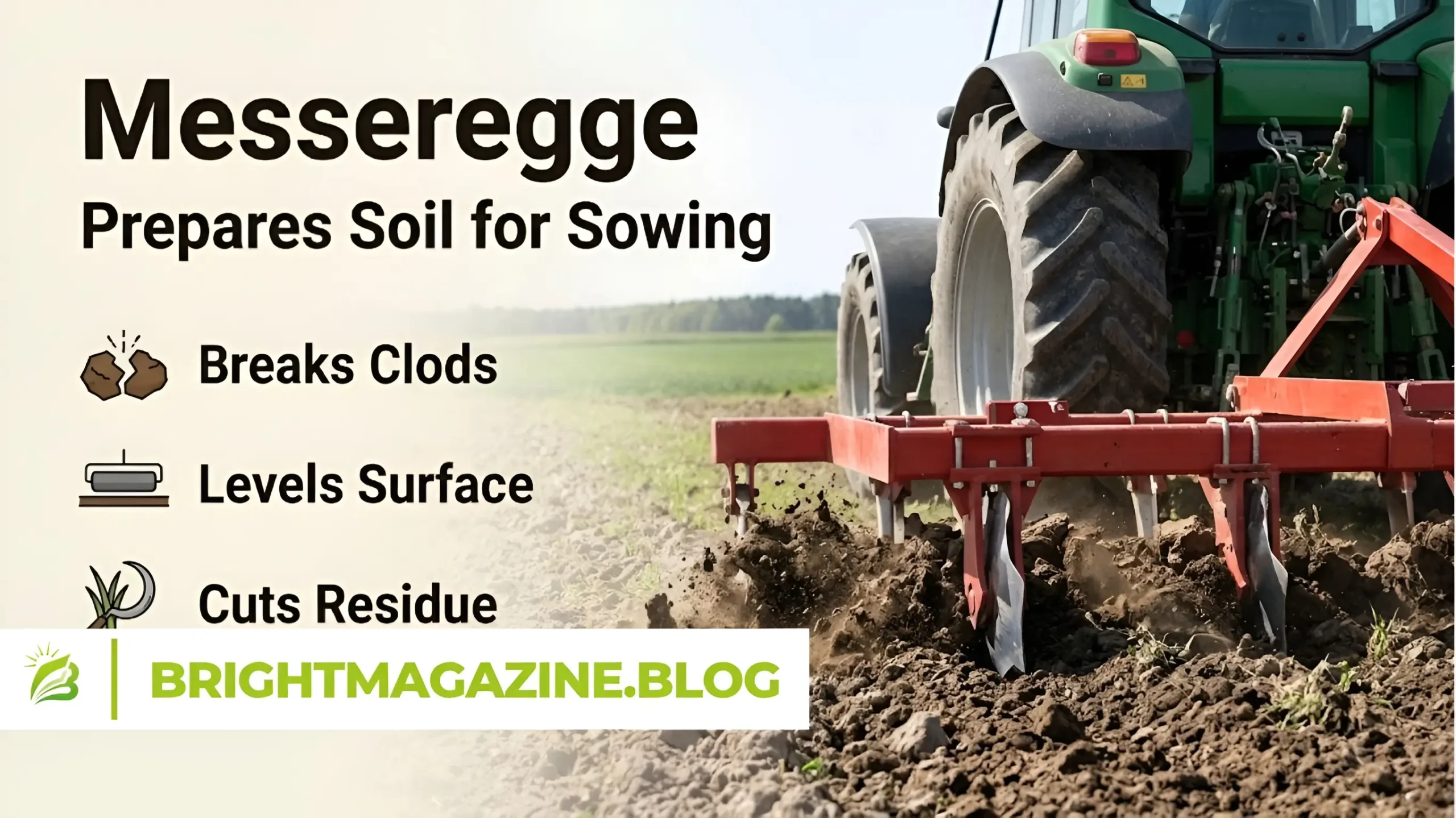
Modern agriculture depends on more than powerful tractors, advanced seed varieties, and efficient irrigation systems. The quality of the soil and the way farmers prepare it before planting are equally important. A well-prepared field can create favorable conditions for seed placement, moisture movement, and early crop development. To achieve these conditions, farmers use different agricultural implements designed to loosen, break, level, or otherwise manage the upper layers of soil. One specialized term associated with this process is Messeregge.
Messeregge is a German agricultural term associated with a knife harrow or blade-equipped soil-working implement. Its name combines the German words Messer, meaning knife, and Egge, meaning harrow. In English-language agricultural discussions, it is useful to describe the equipment as a knife harrow or agricultural scarifier, while recognizing that the precise design depends on the manufacturer and model.
Although Messeregge may be unfamiliar to farmers who primarily use English-language machinery catalogs, the principle behind it is straightforward. An agricultural implement uses specially arranged working elements to interact with the soil surface. Depending on its construction and configuration, it may help break surface clods, improve the evenness of cultivated ground, and support seedbed preparation.
However, no soil-working machine automatically produces the same result in every field. Soil texture, moisture, previous cultivation, residue levels, operating speed, and implement adjustment all influence performance. A machine that works well in one field may provide disappointing results in another if the conditions or settings are unsuitable.
Understanding Messeregge therefore involves more than learning a translation. Farmers, agricultural students, machinery operators, and equipment buyers need to understand how this type of implement fits into a wider cultivation system, what tasks it can perform, where it has limitations, and how to choose equipment for actual farm requirements.
This guide explores the meaning of Messeregge, its working principles, agricultural applications, potential benefits, practical limitations, maintenance requirements, purchasing considerations, and its role in modern soil management.
What Is Messeregge?
Messeregge is a term used in German agricultural machinery contexts to describe equipment associated with knife-like soil-working elements. The most useful general English descriptions are knife harrow, blade harrow, and, in certain contexts, agricultural scarifier.
A conventional harrow can have several types of working elements, including tines, teeth, discs, or other components intended to work the soil. A Messeregge uses knife-like elements as part of its working arrangement. The exact shape, spacing, angle, and movement of these components vary according to the equipment design.
The implement may be used as an individual machine or incorporated into a larger soil-preparation arrangement. Some systems can operate alongside rollers, front packers, or other equipment that performs additional cultivation or soil consolidation tasks.
The purpose is not necessarily to cultivate soil as deeply as a plough. Instead, many applications associated with knife harrows focus on the upper soil layer and the preparation of a suitable surface for subsequent agricultural operations.
It is important to recognize that Messeregge does not automatically identify one universal model with identical dimensions and operating characteristics. A manufacturer may use the term for a particular implement, attachment, or machine configuration. Anyone looking for replacement parts or technical specifications should therefore verify the exact manufacturer, model designation, and equipment documentation.
Why Is Messeregge Important in Agriculture?
Agricultural production often involves several stages of soil management. Depending on the cropping system, farmers may need to break up large clods after primary cultivation, level an uneven surface, manage the upper soil layer, or prepare a field for sowing.
A knife-harrow arrangement can contribute to some of these tasks when its design is appropriate for the field conditions.
For example, imagine a field that has been cultivated but still contains irregular soil clumps. Depending on their size, moisture, and hardness, these clumps may interfere with the desired seedbed structure. A suitably configured surface-working implement may help modify the upper layer before a planting operation.
The objective is not simply to make soil look fine and smooth. Successful soil preparation must balance surface uniformity, suitable soil structure, moisture conservation, and the requirements of the crop being planted.
Messeregge is best understood as one possible tool within this wider process rather than a universal replacement for every cultivation implement.
How Does a Messeregge Work?
The working principle of a Messeregge depends on the model, but the general process involves moving knife-like elements through or across the soil surface. The implement is connected to a suitable tractor or integrated into a compatible agricultural equipment system.
As the machine moves forward, its working elements interact mechanically with the soil. Their arrangement and working angle influence how the soil surface is disturbed.
The result may include cutting, scraping, breaking, or rearranging portions of the upper soil layer. The machine’s frame supports the working elements and helps maintain their position during operation. Additional components, where fitted, may influence depth control, leveling, or the final surface condition.
The Role of the Working Elements
The knives or blades are central to the implement’s function. Their shape, spacing, material, and condition affect how the machine interacts with the ground.
Different arrangements produce different working characteristics. A design intended for one kind of soil preparation may not be equally appropriate for another task.
The knives must therefore be assessed in relation to the intended use, rather than judged by appearance alone.
Farmers considering a Messeregge should investigate whether the working elements are replaceable, how their condition is checked, and whether the manufacturer offers suitable replacement components.
The Importance of Working Depth
Working depth is an important factor in nearly every cultivation operation. A machine operating too deeply may disturb more soil than the task requires, while an unsuitable shallow setting may fail to produce the intended result.
There is no single working depth that can be recommended for every Messeregge. The appropriate setting depends on the equipment’s design, the field surface, soil moisture, clod size, and the purpose of the operation.
Operators should begin with the machine manufacturer’s instructions and make adjustments through controlled field trials. The objective should be to achieve the necessary result with the least unnecessary disturbance.
Working Speed and Soil Conditions
Operating speed can affect the way soil interacts with the working elements. Excessive speed may cause uneven performance, increase vibration, or make the implement harder to control under some conditions. An overly cautious speed can also be inefficient if the equipment is not operating within its intended range.
The appropriate speed depends on the particular machine and field conditions. Operators should follow the manufacturer’s guidance rather than assume that faster travel will always improve productivity.
Moisture is equally important. Very wet soil can deform, smear, or compact under unsuitable traffic and working conditions. Very dry, hard soil may resist the action of the working elements or require a different cultivation approach.
Testing the soil before starting a large field operation can help an operator determine whether the conditions are suitable.
Main Agricultural Uses of Messeregge
The value of a Messeregge depends on the task for which it is selected. Its usefulness should be assessed against the actual problems a farmer needs to solve.
1. Seedbed Preparation
Seedbed preparation is one of the most relevant applications for a knife-harrow type of implement.
A seedbed should provide conditions appropriate for the crop, including suitable soil structure and a reasonably consistent surface. Seed placement becomes more difficult when the field contains excessive irregularities or clods that interfere with the sowing equipment.
A suitably selected Messeregge may help manage the surface after an earlier cultivation operation. It can form part of a sequence involving primary tillage, secondary cultivation, leveling, and sowing.
However, the desired seedbed differs among crops and soils. Some planting systems require a relatively fine surface, while others benefit from retaining more residue or larger soil aggregates. Excessive cultivation is not automatically beneficial.
The machine should support the planting objective rather than simply produce the smoothest possible appearance.
2. Breaking Surface Clods
Clods may develop when soil is cultivated under certain moisture conditions, becomes compacted, or is disturbed by machinery. Their size and strength depend on factors such as soil texture, organic matter, moisture, and the type of previous operation.
Large clods can make subsequent sowing more challenging when they interfere with seed placement or create an irregular field surface.
Depending on its working elements and the condition of the soil, a Messeregge may help break or redistribute some surface clods.
It should not be assumed that every hard clod can be managed efficiently with a knife harrow. Extremely dry or heavily compacted ground may require a different strategy, and working wet soil aggressively may damage its structure.
Correct timing often matters as much as the equipment itself.
3. Surface Leveling
An uneven field can complicate later agricultural operations. Changes in surface height may affect the consistency of planting depth, machinery movement, and the performance of equipment following the initial cultivation stage.
Certain knife-harrow configurations can help redistribute surface soil and reduce small irregularities.
The degree of leveling depends on the frame design, the arrangement of working elements, the field’s initial condition, and the use of any additional leveling components.
A Messeregge should not be confused with specialized land-leveling equipment designed for substantial changes in field elevation. Its suitability for leveling should be determined by the scale and nature of the surface irregularities.
4. Shallow Soil Cultivation
Some agricultural systems seek to manage the upper soil layer without performing deep inversion.
Shallow cultivation may be appropriate when the goal is limited surface disturbance, depending on the crop, soil condition, and farming system. A suitable knife-harrow arrangement can contribute to this type of operation.
Nevertheless, the actual disturbance created by the implement is determined by its geometry and operating settings. A farmer should not assume that every machine sold under a similar name performs the same operation.
The manufacturer should provide the relevant information on working depth, intended applications, and operating limitations.
5. Supporting Multi-Stage Cultivation
Farm machinery is frequently used in combinations rather than in isolation. One implement may perform an initial operation, while a second machine refines the soil surface or prepares the ground for planting.
A Messeregge may be used as part of such a system where the equipment is designed for compatible mounting and operation.
For example, a knife-harrow attachment may work ahead of a roller or packer in a suitable configuration. The first component modifies the soil surface, while the following component may perform additional leveling, clod management, or consolidation.
Whether this arrangement is beneficial depends on the machines involved and the intended soil condition. Compatibility, tractor capacity, weight distribution, visibility, and safe operation must all be considered.
6. Mechanical Management of the Soil Surface
Mechanical soil management can be part of a wider crop-production strategy. Depending on its design, an appropriate surface implement may help disturb the upper soil layer and alter the position of some small weeds or plant residues.
However, a Messeregge should not automatically be described as a universal weed-control solution. Weed control depends on species, growth stage, root development, soil conditions, and the timing and quality of the operation.
Farmers should select equipment based on the specific management objective and confirm that the implement is designed for it.
Main Components of a Messeregge
Although construction differs by manufacturer, understanding the likely components of this class of implement can help farmers assess equipment quality and maintenance needs.
Supporting Frame
The frame supports the working elements and connects the implement to the tractor or associated machine.
Frame strength, dimensions, mounting points, and construction quality influence suitability for the intended work. Buyers should look for visible damage, distortion, corrosion, poorly repaired areas, or loose connections when inspecting used machinery.
A frame that appears structurally sound should still be checked against the manufacturer’s specifications before purchase or operation.
Knives or Blade-Like Working Elements
The working elements interact with the soil and are subject to wear. Their shape and arrangement are important to the machine’s function.
Inspection should focus on excessive wear, cracks, deformation, missing components, and uneven condition across the implement.
Where replacement is necessary, parts should match the machine’s intended specifications. An improvised replacement may affect working performance or introduce a safety risk.
Mounting and Adjustment Mechanisms
Mounting components hold the implement in its operating position, while adjustment mechanisms allow the operator to configure it according to the design.
These parts should move and secure correctly. Damaged pins, worn mounting points, loose bolts, or faulty adjustments can affect alignment and stability.
Before buying used machinery, the buyer should confirm that essential mounting hardware and adjustment components are present and functional.
Optional Rollers or Packers
Some equipment combinations include rollers or packers that perform an additional soil-management function.
These should not be assumed to be standard parts of every Messeregge. Their presence and purpose depend on the specific machine or system.
When a roller is included, its condition, bearing arrangements, mounting, and compatibility with the working implement should be examined separately.
Wear Parts and Fasteners
Agricultural equipment operates under demanding conditions. Abrasion, vibration, and repeated loading may gradually affect knives, fasteners, bearings, and other serviceable components.
A practical ownership assessment should include the availability and cost of replacement parts, the tools required for routine maintenance, and the level of technical support provided by the seller or manufacturer.
Benefits of Using a Messeregge
The advantages of a Messeregge are conditional. They depend on whether the machine is suited to the field and whether it is operated properly.
Improved Surface Preparation
A suitable knife-harrow configuration may help create a more consistent surface after prior cultivation.
This can make the next operation easier when surface clods and small irregularities are the main problems. The benefit should be assessed by examining the actual field and not simply by judging the machine’s appearance or advertised capabilities.
A Useful Role in a Larger Cultivation System
An implement that performs one well-defined operation can make a wider machinery system easier to manage.
A Messeregge may provide a useful intermediate step between primary soil preparation and sowing, especially where its working characteristics match the desired seedbed.
The key is appropriate integration. A machine that duplicates work already performed by another implement may add cost without delivering a meaningful improvement.
Potential for More Targeted Soil Disturbance
Where the design allows shallow working, a suitable implement may help operators avoid unnecessary deeper cultivation for tasks that only require surface management.
This can be valuable when the farm’s agronomic objectives favor controlled disturbance.
However, actual depth and disturbance must be verified for the model. A machine should never be labeled a low-disturbance solution solely because of its name.
Flexible Use Within Suitable Operations
Different farms have different field sizes, crops, soils, and machinery arrangements.
A Messeregge may suit one farm as an independent operation and another as an attachment within a more extensive system. This flexibility is useful when the machine fits the farm’s existing equipment and planned workflow.
Flexibility should not be confused with universal compatibility. Tractor requirements, mounting dimensions, transport arrangements, and working conditions still need checking.
Potential Time Savings
When an implement performs a required operation effectively, it may reduce the need for separate passes or improve the flow of fieldwork.
But the actual time saving depends on field size, operating speed, turning time, implement width, overlap, soil conditions, and the number of operations that remain necessary.
A farm should evaluate these factors before assuming that purchasing a Messeregge will reduce labor or fuel use.
Support for Consistent Fieldwork
Consistency can matter as much as raw operating capacity. A well-adjusted machine that produces a suitable surface across the field may be more useful than a larger machine that gives uneven results.
Regular inspections, proper setup, and careful operating practices help support consistency.
Limitations and Challenges to Consider
A balanced assessment of Messeregge should include its possible disadvantages. No single implement is suitable for every field operation.
Performance Depends on Soil Type
Sandy, loamy, and clay-rich soils differ in their structure, cohesion, moisture behavior, and response to mechanical disturbance.
An implement that works satisfactorily in one soil may behave differently in another. Some soils form hard clods under certain conditions, while others may be vulnerable to smearing or compaction when wet.
Field testing and advice from a qualified agricultural machinery specialist can help determine whether a particular configuration is appropriate.
Moisture Can Limit Effective Operation
Working soil when it is too wet can damage structure and increase the risk of compaction. Working very hard, dry soil may make surface treatment difficult.
The correct operating window depends on local soil conditions and the task being performed.
Operators should inspect the field before beginning and stop or adjust the operation if the soil is deforming, sticking excessively, or failing to respond as intended.
It Cannot Replace Every Tillage Implement
A Messeregge is not automatically a substitute for a plough, cultivator, disc harrow, rotary harrow, or dedicated leveling machine.
Each implement has a different working mechanism and potential application. The correct choice depends on the agronomic problem rather than the general desire to prepare land.
Using a machine outside its intended purpose can result in poor field conditions, extra passes, unnecessary expense, or excessive soil disturbance.
Initial and Ongoing Costs
The purchase price represents only part of the cost of ownership.
The buyer may also need to consider transport, mounting equipment, wear parts, routine servicing, storage, compatibility modifications, and any additional tractor requirements.
A lower purchase price does not necessarily represent better value if replacement components are difficult to source or the machine is unsuitable for the work.
Operator Experience Matters
Correct use depends on understanding the implement, reading the operating instructions, recognizing unsuitable field conditions, and adjusting the machine carefully.
Inexperienced operation can lead to uneven results or unnecessary mechanical wear.
Training, practical demonstrations, and conservative initial settings are useful ways to reduce avoidable problems.
How to Choose the Right Messeregge
Selecting the right implement involves matching machinery characteristics with the requirements of the farm.
Identify the Primary Task
Begin by defining the problem.
Does the field need surface clods managed after primary tillage? Is the main goal to create a consistent seedbed? Does the existing machinery leave small ridges or irregularities? Is the equipment intended to work with a roller or another attachment?
The answers will help narrow the options and avoid buying a machine that performs a different operation from the one required.
Examine Soil Conditions
Consider the soil texture, typical moisture conditions, amount of residue, and the physical state of the field after existing cultivation operations.
If a field frequently develops hard clods, ask the supplier how the proposed machine performs under comparable conditions. If the soil is often wet during the intended work period, investigate whether the implement is appropriate for those conditions.
Local experience is useful, but it should be supported by the specifications for the actual model.
Check Working Width
Working width influences the amount of ground covered during each pass.
A wider machine may cover more area per pass, but it also needs suitable tractor capacity, transport arrangements, field access, and enough turning space.
A smaller implement may be more practical for irregular fields or farms with limited machinery capacity.
The best width is the one the farm can operate effectively and safely, not necessarily the largest model available.
Verify Tractor Compatibility
The tractor and implement must work together within their approved operating limits.
Check the mounting system, required hydraulic connections, relevant weight limits, lift capacity, visibility, and the manufacturer’s tractor recommendations.
Do not assume that a tractor capable of pulling one implement can automatically carry or control a different one of similar width.
Professional advice is particularly important when using a front-mounted implement or combining several machines in one arrangement.
Investigate Parts Availability
Replacement knives and other wear components may be necessary during the machine’s service life.
Before purchasing, ask about part numbers, delivery times, local dealer support, and the cost of common replacement items.
For a used machine, confirm that replacement parts remain available and that the equipment has not been modified in ways that make components difficult to obtain.
Compare New and Used Equipment
New equipment may offer a warranty, manufacturer support, and a clearer service history.
Used equipment can be an economical alternative, particularly when the machine has been maintained carefully. However, a used purchase requires more detailed inspection.
Look for structural damage, missing components, excessive wear, loose connections, corrosion, and evidence of poor-quality repairs.
The buyer should also ask why the machine is being sold and whether it has been used for the intended type of work.
Request a Practical Demonstration
A demonstration can reveal details that a product description cannot.
Observe how the machine handles the actual soil type, whether working depth remains consistent, how the surface looks after the pass, and whether the implement works smoothly with the tractor.
The demonstration should reflect realistic field conditions. Results from an unusually favorable plot may not represent performance across the entire farm.
Best Practices for Operating a Messeregge
Proper operation supports reliable performance and reduces avoidable wear.
Before entering the field, inspect the implement for missing knives, damaged mounting points, loose fasteners, and other visible problems. Confirm that the machine is connected correctly and that relevant safety features are in place.
Next, assess the field. Check soil moisture, existing clod conditions, residue distribution, surface irregularities, and any obstacles that may affect the operation.
Select the initial settings according to the manufacturer’s instructions. Rather than beginning with a full field, test the machine on a limited section.
After the trial pass, stop safely and inspect the result. Look for uniformity, excessive disturbance, untreated patches, unwanted ridges, or signs that the soil is too wet or hard for effective work.
Adjust only after identifying the likely cause of the problem. Changing several settings at once can make it difficult to determine which adjustment improved or worsened the result.
During the main operation, maintain a consistent working approach. Monitor machine behavior, listen for unusual sounds, and watch for changes in the soil surface.
If the implement begins vibrating unusually, becomes obstructed, or behaves differently from normal, stop in accordance with the safe shutdown procedure and investigate before continuing.
At the end of the job, clean the equipment as appropriate and inspect components that may have collected soil or debris. Record any damage, service requirements, or settings that worked well.
These small practices help turn machinery operation into a repeatable farm process rather than a series of adjustments made without a clear objective.
Maintenance and Care
Maintenance is essential to keeping agricultural equipment in usable condition. The specific schedule for a Messeregge should come from the manufacturer’s instructions, but several general practices are useful.
Inspect Working Elements Regularly
Examine knives or blades for wear, cracks, deformation, and missing fasteners. Uneven wear across the machine may indicate that alignment or operating conditions need attention.
Replace damaged parts with components intended for the particular model.
Check Fasteners and Connections
Vibration and repeated loading may loosen connections over time. Inspect bolts, pins, mounting brackets, and adjustment mechanisms according to the maintenance schedule.
Use the recommended tightening procedures and specifications. Excessive tightening or unsuitable replacement hardware can also create problems.
Clean After Use
Remove accumulated soil and plant material where appropriate. Cleaning makes it easier to identify damage and helps prevent debris from interfering with moving or adjustable parts.
Follow any cleaning restrictions in the manual, particularly around bearings, lubrication points, and hydraulic components.
Lubricate as Required
Where the machine contains lubrication points, service them at the intervals and with the products specified by the manufacturer.
Do not assume that every model has identical lubrication requirements. Some components may be sealed, while others may require routine attention.
Store the Implement Properly
When the implement is not being used, store it on suitable ground or supports in accordance with its instructions.
Protect the equipment from unnecessary exposure to moisture, inspect it before the next season, and keep service records where practical.
A basic maintenance log should record inspections, replacement parts, repairs, and other important work.
Safety Considerations When Using a Messeregge
Agricultural machinery can cause serious injuries when handled incorrectly. Knife-like working elements, heavy frames, tractor movement, hydraulic systems, and raised equipment all require care.
Before maintenance or inspection, park the tractor on stable ground, follow the manufacturer’s shutdown instructions, lower the equipment into a safe position where appropriate, and prevent unexpected movement. Never reach under an unsupported implement.
Wear suitable protective equipment when handling sharp or heavy components. Use the correct lifting and support equipment rather than relying on a hydraulic system alone.
Keep other people away from the operating area and ensure the operator can see the path of travel. Be especially cautious when an implement is mounted at the front of the tractor, since visibility and turning behavior may differ from those of a conventional rear-mounted implement.
Before transporting machinery on public roads, check the relevant local requirements, including width, lighting, visibility, secure mounting, and transport position.
Always follow the operating manual for the exact implement and tractor combination. General advice cannot replace model-specific safety instructions or applicable legal requirements.
Messeregge Compared With Other Agricultural Implements
Choosing the correct implement becomes easier when its role is compared with that of other soil-working machines.
Messeregge Versus a Plough
A plough is generally used for primary tillage and may turn over a layer of soil. Depending on the plough design and operating depth, it can bury residue and alter the soil profile within the cultivated layer.
A knife harrow is more closely associated with surface-oriented soil preparation, although the actual function depends on its design.
The two implements therefore have different roles. A farmer who needs deep inversion should not assume that a Messeregge will provide the same result.
Messeregge Versus a Disc Harrow
A disc harrow uses concave or otherwise shaped discs to cut and move soil. It may be selected for tasks involving residue management, clod reduction, or secondary tillage, depending on its configuration.
A Messeregge uses knife-like working elements rather than the same disc arrangement.
The better choice depends on the field condition, residue level, desired depth, and the machine’s actual performance under local conditions.
Messeregge Versus a Rotary Harrow
A rotary harrow uses mechanically driven rotating working elements. A powered arrangement can create a different pattern of soil movement from a passive knife-harrow design.
The power requirement, working action, maintenance needs, and suitability for different soil conditions can therefore differ considerably.
Farmers should compare the intended result and ownership costs rather than assume that one machine is universally better.
Messeregge Versus a Cultivator
The term cultivator covers a broad range of implements with different tine arrangements and working depths.
Some cultivators are intended for deeper loosening, while others focus on shallow cultivation or residue management. A knife harrow may overlap with selected applications, but it is not necessarily interchangeable with every cultivator.
A useful comparison begins with the actual machine specifications and the problem to be solved.
Illustrative Case Studies: How a Messeregge Might Fit Into Farm Operations
The following examples are hypothetical planning scenarios. They illustrate how a farmer could assess the suitability of a Messeregge; they are not reports of verified farms, measured trials, or guaranteed results.
Case Study 1: A Field With Uneven Surface Clods
Imagine a farm where primary cultivation leaves a field with a mixture of small clods and uneven surface patches. The farm’s next operation is sowing, and the operator wants to improve the surface without unnecessarily repeating the deeper cultivation stage.
The farmer first examines the soil moisture and determines whether the clods can be managed under the current conditions. The farmer then checks whether a proposed Messeregge is intended for this type of surface preparation.
A short demonstration is carried out before the entire field is treated. The operator compares the surface before and after the pass, paying attention to clod distribution, leveling, and any signs of excessive disturbance.
If the result meets the seedbed requirements, the machine may be considered a suitable part of the cultivation sequence. If the surface remains too rough or the soil is too hard, the operator may need to change the timing or evaluate another implement.
The lesson is that equipment selection should follow field diagnosis. The farmer should identify the problem and test the proposed solution instead of assuming that a knife harrow will solve every soil condition.
Case Study 2: A Farm Considering a New Machinery Purchase
Consider a medium-sized farm that already owns a tractor, a primary tillage implement, and a seed drill. The farm is considering a Messeregge to address a recurring problem with surface preparation.
Before buying, the owner estimates how often the operation is necessary, whether existing machinery can already achieve the desired result, and whether adding another implement would improve the overall workflow.
The owner requests information about compatible mounting arrangements, working width, wear parts, maintenance requirements, and the availability of local technical support.
A field demonstration is then used to evaluate practical results. The owner records the working time, tractor requirements, condition of the soil after treatment, and any additional operation still needed before sowing.
The purchase decision is based on this evidence rather than on a general claim that a particular machine increases productivity.
In this scenario, the most important question is not whether the Messeregge is an advanced piece of agricultural equipment. It is whether it solves a sufficiently important problem to justify its total cost.
Case Study 3: A Farm Comparing Different Soil Conditions
Imagine a farm with two fields. One field has a loamier texture and produces manageable surface clods after cultivation. The other contains heavier soil that becomes sticky in wet conditions and hard when excessively dry.
The operator considers using the same machine in both locations.
Instead of assuming identical performance, the operator tests the implement separately in each field and evaluates the soil response. The first field may provide an acceptable result under suitable moisture conditions, while the second may require a narrower operating window or a different cultivation approach.
The farm keeps records of the settings used and the surface conditions observed.
This example illustrates why machinery recommendations should account for local differences. A tool can be appropriate for one field and unsuitable for another on the same farm.
Case Study 4: A Farm Reviewing Maintenance and Downtime
A farm uses a knife-harrow implement over several seasons. During a pre-season inspection, the operator discovers that some working elements are more worn than others and that a mounting connection requires attention.
Rather than beginning fieldwork immediately, the operator checks the manual, obtains appropriate replacement parts, and carries out the required maintenance.
During the following operation, the operator pays attention to alignment and surface consistency and documents any further issues.
This approach may help the farm identify problems early and avoid preventable interruptions during a busy planting period.
The broader lesson is that machinery value depends on more than the initial purchase. Inspection, suitable replacement components, safe storage, and timely maintenance all contribute to the long-term usefulness of agricultural equipment.
Understanding the Cost and Value of a Messeregge
The financial value of a Messeregge should be evaluated in the context of the entire cultivation system.
The purchase price is only one part of the calculation. Other considerations include maintenance, replacement knives, storage, mounting requirements, tractor compatibility, fuel use, operator time, and the cost of any additional passes.
A farm should also consider whether the implement reduces an existing problem or simply adds another stage to an already effective system.
One useful method is to document the current operation before considering a purchase. Record the equipment currently used, the time required, the result achieved, and the problems that remain.
After a demonstration with the proposed machine, compare the same practical factors. This creates a more useful basis for decision-making than relying on a broad promise of lower costs or increased productivity.
Used machinery should be assessed with particular care. A discounted machine may be good value when its frame is sound, working components are serviceable, and replacement parts remain available. Hidden damage or unavailable components can make an apparently inexpensive purchase costly.
The most economical option is the one that performs the required task safely and consistently at an acceptable total cost over its useful life.
The Role of Messeregge in Modern Soil Management
Modern agriculture increasingly requires farmers to balance field productivity with long-term soil condition. Soil structure, water movement, erosion risk, organic matter, and traffic management can all influence the sustainability of a cropping system.
The role of a Messeregge within this context depends on how it is used. Mechanical cultivation can help prepare a suitable surface, but unnecessary passes may increase fuel use, disturb soil aggregates, or expose soil to erosion under unfavorable conditions.
A thoughtful cultivation strategy therefore begins with the crop’s requirements and the condition of the field.
Farmers should ask whether another pass is genuinely needed, whether the existing soil surface is already adequate, and whether the proposed operation could cause more disturbance than necessary.
Residue retention, crop rotation, cover crops, controlled traffic, and other soil-management practices may also influence the decision. The right combination varies according to climate, soil type, production goals, and local agricultural advice.
A Messeregge is best viewed as one tool that can contribute to a carefully planned system. Its value comes from how well it supports the required operation, not from using machinery for its own sake.
Common Mistakes to Avoid When Choosing or Using a Messeregge
Several avoidable mistakes can reduce the value of agricultural equipment.
The first is buying a machine without defining its intended task. A farmer should identify whether the problem concerns clods, surface leveling, shallow cultivation, or another specific operation before comparing models.
The second is overlooking soil moisture. Even a suitable implement may produce a poor result when the field is too wet or too hard. Checking soil conditions before work begins can prevent unnecessary passes and damage.
The third is assuming all machines described as Messeregge have identical working characteristics. Design, working width, mounting system, adjustment, and intended use may differ between models.
The fourth is choosing equipment based on size alone. Wider machinery is not automatically more economical if the tractor cannot operate it properly or the fields are difficult to access.
The fifth is neglecting maintenance. Worn knives, damaged connections, and missing components can affect performance and safety.
Another mistake is treating a visually smooth seedbed as the only measure of success. The soil must also suit the crop, sowing method, moisture conditions, and wider agronomic plan.
Finally, operators should avoid making adjustments without a clear method. Controlled trial passes and careful observation provide better information than changing settings repeatedly across a whole field.
Frequently Asked Questions About Messeregge
Q1: What does Messeregge mean in English?
A: Messeregge is a German agricultural term associated with a knife harrow or a blade-equipped soil-working implement. Depending on the equipment and context, it may also be described as an agricultural scarifier. The exact machine design should be checked before selecting an English equivalent.
Q2: What is a Messeregge used for?
A: A suitable Messeregge may be used for surface soil preparation, clod management, leveling, or other cultivation tasks supported by its design. Its actual application depends on the working elements, operating settings, soil conditions, and the manufacturer’s intended use.
Q3: Is Messeregge a type of harrow?
A: Yes, in its agricultural context, the term is associated with a knife- or blade-equipped harrow. However, it does not guarantee a single standardized design. Different manufacturers may use the term for different models or equipment configurations.
Q4: Is a Messeregge the same as a scarifier?
A: The terms can overlap in translation, but they are not always interchangeable. Scarifier can describe different kinds of soil-working machinery in English. The correct comparison depends on the machine’s construction, working depth, and intended function.
Q5: Can a Messeregge prepare a seedbed?
A: A suitable model can contribute to seedbed preparation by helping manage the upper soil surface. Whether it produces the required result depends on the crop, field condition, soil moisture, previous cultivation, and the requirements of the sowing equipment.
Q6: Can a Messeregge replace a plough?
A: Not in every situation. A plough is generally used for primary tillage and soil inversion, whereas a knife harrow is associated more closely with surface-oriented preparation. The machines perform different functions and should be selected according to the required operation.
Q7: Does every Messeregge work with a roller or packer?
A: No. Some equipment configurations may be designed to work with a roller or packer, while others may operate independently. Buyers should verify the manufacturer’s specifications and compatibility requirements for the exact machine.
Q8: What factors affect Messeregge performance?
A: Important factors include soil type, moisture, clod size, residue conditions, implement design, working depth, operating speed, and the condition of the working elements. Tractor compatibility and correct adjustment also matter.
Q9: How should a Messeregge be maintained?
A: Maintenance should follow the manufacturer’s instructions. General tasks include inspecting knives and blades, checking fasteners and mounting points, cleaning accumulated soil, lubricating specified components, replacing worn parts, and storing the implement safely.
Q10: Is a Messeregge suitable for every soil type?
A: No single implement performs equally well in every soil condition. The suitability of a Messeregge depends on its design and the field’s physical characteristics. A controlled field demonstration can help determine whether it is appropriate for a specific farm.
Q11: What should buyers inspect before purchasing a used Messeregge?
A: Buyers should examine the frame, working elements, fasteners, mounting hardware, adjustment mechanisms, and any included rollers or additional components. They should also verify the model identity, replacement-part availability, maintenance history, and compatibility with the intended tractor.
Q12: Is Messeregge a brand name?
A: The word is used in an agricultural machinery context and should not automatically be interpreted as the name of one specific brand. A particular manufacturer may use it in a product description, but buyers should identify the actual manufacturer and model when looking for specifications or spare parts.
Q13: How can a farmer decide whether a Messeregge is worth buying?
A: The farmer should identify a specific fieldwork problem, evaluate existing machinery, check compatibility and operating requirements, and request a demonstration under realistic conditions. The final decision should account for the purchase price, maintenance, replacement parts, labor, and the results actually achieved.
Conclusion
Messeregge is a useful agricultural term to understand when exploring specialized soil-preparation equipment. It is associated with a knife harrow or blade-equipped implement that may contribute to surface cultivation, clod management, leveling, and seedbed preparation when the design and field conditions are appropriate.
Its practical value depends on more than the name or appearance of the machine. Soil type, moisture, working depth, tractor compatibility, operating technique, maintenance, and the requirements of the next agricultural operation all influence whether the implement is suitable.
For farmers and equipment buyers, the most reliable approach is to define the task first, review the specifications for the exact model, and evaluate performance through careful field observation. A Messeregge may be a useful addition to a well-planned cultivation system, but it should not be treated as a universal replacement for other agricultural implements.
Ultimately, successful soil preparation comes from matching the right equipment to the right conditions and using it with a clear understanding of the desired result. When a Messeregge fits that purpose, it can play a practical role in the wider process of preparing agricultural land for productive crop establishment.
For More Visits: Bright Magazine
Also Read: Babeltee: Meaning, Ingredients, Benefits & Recipe
