

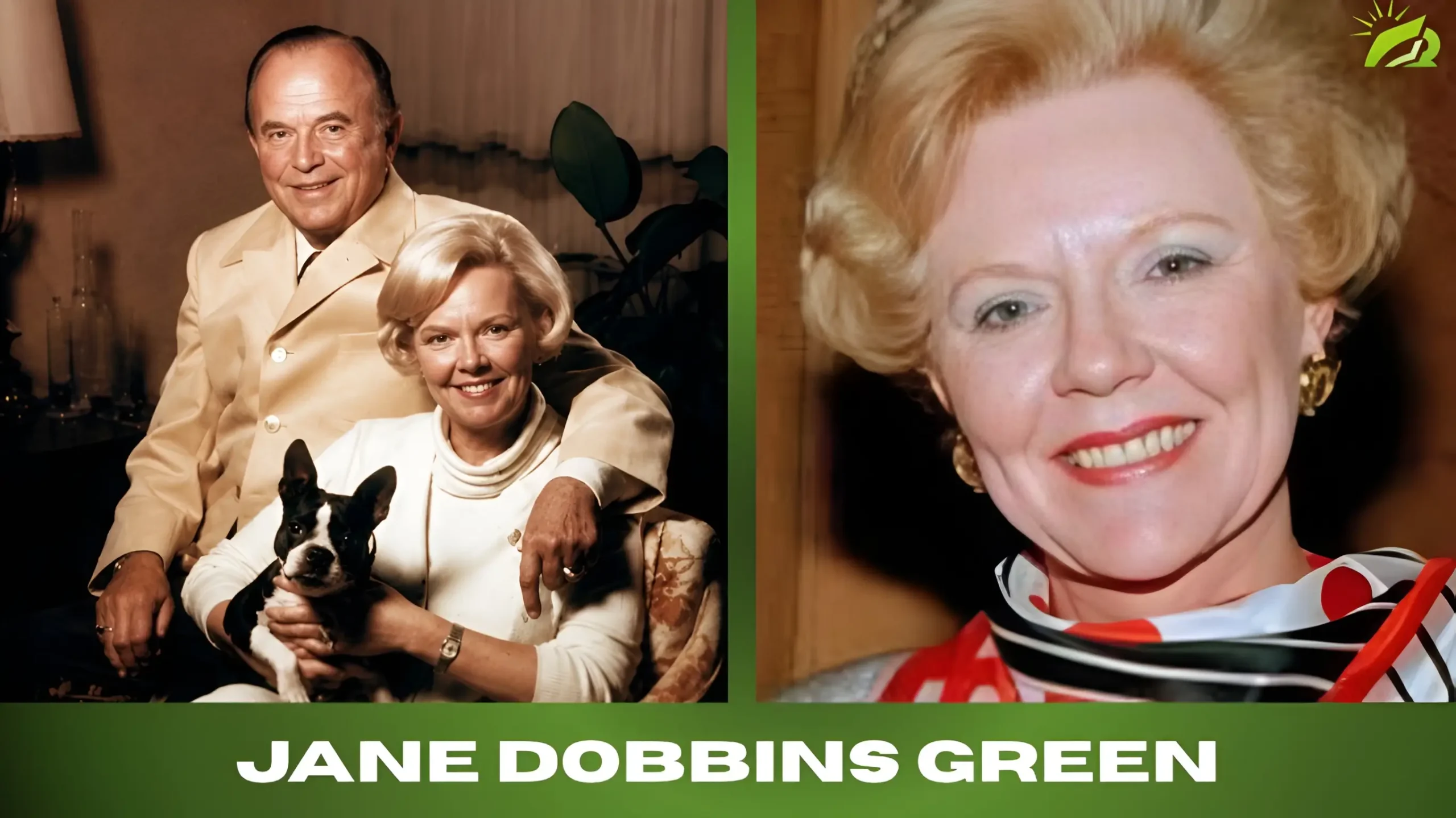
Jane Dobbins Green is a name that frequently appears in searches about Ray Kroc, the businessman who helped transform McDonald’s into one of the most recognizable restaurant brands in the world. Although Kroc’s professional achievements have been discussed in countless biographies, documentaries, and business histories, the women connected to his personal life have attracted different levels of public attention. Jane Dobbins Green remains one of the less widely known figures in his story.
Jane is primarily remembered as Ray Kroc’s second wife. Their marriage began in 1963 and ended in 1968, placing their relationship during a significant period in the expansion of McDonald’s. Before marrying Kroc, Jane was associated with Hollywood through her reported work as a secretary for actor John Wayne. Her connection to the entertainment industry and subsequent marriage to a prominent businessman make her an interesting subject for readers exploring American cultural and business history. These details are discussed in the Society for American Baseball Research’s biographical account of Ray and Joan Kroc and in Kroc’s autobiography, Grinding It Out.
Yet the story of Jane Dobbins Green is not as extensively documented as that of her former husband. Much of the available information comes from accounts of Ray Kroc’s life rather than interviews, autobiographical writing, or public statements made by Jane herself. This distinction matters because it is easy for modern biographies to fill gaps in the historical record with assumptions or unsupported details.
Understanding Jane’s life therefore requires a balanced approach. Her documented connection to Hollywood, marriage to Ray Kroc, place in his family history, and separation from him can be examined without inventing details about her private experiences. Similarly, her comparatively limited public profile should not automatically be interpreted as evidence that she deliberately rejected fame or spent her later years in a particular way.
This article explores Jane Dobbins Green’s background, reported career, relationship with Ray Kroc, connection to the McDonald’s story, and the questions that continue to surround her biography. It also distinguishes Jane from Joan Kroc, explains what is and is not established about her life after divorce, and addresses common questions about her age, family, wealth, and legacy.
For readers searching for Jane Dobbins Green, the goal is to provide a fuller, carefully considered account of the woman behind the name while respecting the limits of what the historical record can establish.
Who Was Jane Dobbins Green?
Jane Dobbins Green was an American woman best known publicly for her marriage to Ray Kroc. Kroc became a central figure in the growth of McDonald’s after recognizing the commercial potential of the restaurant system developed by Richard and Maurice McDonald. His business career eventually made him a household name, while his personal relationships became subjects of interest for biographers and readers investigating the history behind his success.
Jane entered this story in the early 1960s. According to historical accounts, she had worked as a secretary for John Wayne before meeting Kroc. She and Kroc married in 1963 and divorced in 1968. This five-year marriage occupies a relatively small portion of Kroc’s overall biography, but it remains an important part of his documented personal history.
Unlike Kroc, Jane did not become widely recognized as a business executive or public spokesperson. Her name is generally discussed in relation to her marriage rather than through an extensive record of professional achievements or public appearances. That does not make her life unimportant; it simply means that the available historical narrative is narrower.
The distinction between public recognition and personal significance is central to understanding her story. Jane had a life before she met Kroc, and her identity cannot be reduced entirely to her former marriage. At the same time, there is insufficient reliable material to reconstruct every part of her life independently of that relationship.
A responsible biography should therefore establish the known facts first and treat uncertain details with caution. Jane’s relationship with Ray Kroc provides a starting point, but it is not a complete explanation of who she was as an individual.
Early Life and Family Background
Information about Jane Dobbins Green’s early life is limited compared with the material available about Ray Kroc. Historical biographical research identifies her original name as Jane Elizabeth Dobbins and gives Walla Walla, Washington, as her birthplace. The same research places her birth in 1911 and identifies her parents as David and Grace Dobbins.
These details offer a starting point for understanding her background, but they do not provide a comprehensive picture of her childhood. The available historical accounts do not establish a detailed timeline of her upbringing, her education, the circumstances of her family life, or the experiences that shaped her personality.
It is tempting to use general assumptions about the period to fill those gaps. Someone born in the United States in the early twentieth century would have lived through major social and economic changes, including the Great Depression and the transformation of American popular culture. However, those historical circumstances alone cannot tell us how Jane personally experienced them.
Without dependable first-person accounts or well-established biographical evidence, claims about her childhood ambitions, family relationships, or private struggles would be speculation. A careful examination must distinguish the broader historical environment from facts about an individual person.
The information that is available suggests that Jane’s life before her marriage included a professional connection to Hollywood. This detail is more directly relevant to her later biography because it is associated with Ray Kroc’s own account of their relationship.
Her early life remains an area where further documentary research could add meaningful context. Birth records, contemporary newspaper archives, employment records, and authenticated family documents might help researchers establish additional details. Until those details are corroborated, it is more accurate to acknowledge the limits of the surviving public narrative than to manufacture an elaborate childhood story.
Jane Dobbins Green’s background illustrates an important point about historical biography: a person can be connected to a famous public figure without leaving behind an equally extensive record of their own life.
Jane Dobbins Green’s Career Before Meeting Ray Kroc
One of the most notable details about Jane Dobbins Green’s life before her marriage is her reported professional connection to Hollywood. Ray Kroc identified Jane as John Wayne’s secretary in his autobiography, Grinding It Out: The Making of McDonald’s. This personal account is an important source for understanding how Jane entered his life.
John Wayne was a major Hollywood star whose career made him one of the most recognizable actors of his generation. Working as a secretary for someone with such a prominent public profile could place an individual in a professional environment shaped by the entertainment industry. Nevertheless, the available evidence does not establish the complete details of Jane’s employment, the length of time she worked for Wayne, or the exact responsibilities she performed.
It would therefore be inaccurate to describe Jane as an actress, film producer, studio executive, or celebrity manager without supporting evidence. Her documented association with Wayne is sufficient to make her background interesting without adding unsupported professional accomplishments.
Secretarial work itself could involve many responsibilities, depending on the employer and the period. Communication, correspondence, scheduling, organization, and administrative assistance were common aspects of such positions. However, these general responsibilities should not be presented as a verified description of Jane’s individual duties.
Her Hollywood connection also provides an important distinction between her own background and her later association with McDonald’s. Jane’s connection to the restaurant corporation came through her marriage to its prominent businessman, not through any established record of her holding an executive position within the company.
This aspect of her biography helps explain why readers interested in classic Hollywood sometimes encounter her name while researching Ray Kroc. It also demonstrates how the personal histories of people from different industries can become connected through relationships.
Although the surviving record does not provide a complete account of Jane’s career, the reported work associated with John Wayne remains one of the most concrete details in her life before her marriage to Kroc.
How Jane Dobbins Green Met Ray Kroc
The meeting between Jane Dobbins Green and Ray Kroc marked the beginning of the relationship for which Jane would later become best known. Their story developed during a period when Kroc was intensely focused on building his business and establishing his position in the American restaurant industry.
In his autobiography, Kroc described meeting Jane through a mutual acquaintance. He recalled being attracted to her personality and recounted how they began spending time together shortly after their introduction. His account describes a remarkably rapid courtship, with the pair meeting for dinner on successive evenings.
The brevity of their courtship is one of the details that makes their relationship notable to readers. The marriage reportedly took place only about two weeks after they met. Such a short period between an introduction and a wedding may appear surprising to modern readers, particularly when compared with contemporary expectations about dating and long-term compatibility.
However, the length of a courtship alone cannot determine the quality or eventual outcome of a relationship. People make significant personal decisions under different circumstances, and the public record does not provide enough information to reconstruct every consideration that influenced Jane and Kroc.
It is also important to recognize that the surviving narrative is largely shaped by Kroc’s recollections. His autobiography offers a useful first-person account, but it reflects his own memories and interpretation of events. It should not automatically be treated as a complete description of Jane’s feelings, motivations, or understanding of the relationship.
Jane’s perspective is less extensively represented in the publicly available material. Without a comparable personal account from her, it would be inappropriate to attribute specific intentions or emotions to her at the time.
What can be established is that the couple met in the early 1960s, developed a relationship quickly, and married in 1963. Their union brought Jane into the personal life of a businessman whose company was entering an important phase of growth.
Their marriage subsequently became one chapter in a much larger history involving entrepreneurship, family relationships, and the development of a globally recognized restaurant brand.
When Did Jane Dobbins Green Marry Ray Kroc?
Jane Dobbins Green married Ray Kroc in 1963. Historical biographical accounts give February 23, 1963, as their wedding date and report that the couple met only shortly before the marriage. Their relationship continued until their divorce in 1968.
A timeline helps put the marriage into context.
- Before 1963: Jane had an independent life and was associated with Hollywood through her reported work as John Wayne’s secretary.
- 1963: Jane married Ray Kroc, becoming his second wife.
- 1963–1968: Their marriage formed part of Kroc’s personal life during his growing involvement in the expansion of McDonald’s.
- 1968: The marriage ended in divorce.
- 1969: Kroc married Joan Mansfield Smith, later widely known as Joan Kroc.
These milestones establish the broad outline of Jane’s relationship with Kroc without suggesting that the available records reveal every detail of their private lives.
Their marriage is sometimes overshadowed by Kroc’s other relationships. His first marriage to Ethel Fleming lasted for decades, while his third marriage to Joan Kroc became especially prominent in later accounts of philanthropy and the Kroc family legacy. Jane’s marriage occupied the intervening period.
That position between two better-known relationships is one reason her biography can be difficult for casual readers to follow. Someone searching for information about Ray Kroc’s wives may encounter details about all three women mixed together, even though their lives and roles were different.
Jane should therefore be identified accurately as Kroc’s second wife. Ethel Fleming was his first wife, and Joan Mansfield Smith was his third. Maintaining this distinction is essential to an accurate account of his family history.
Ray Kroc and McDonald’s During Their Marriage
To understand why Jane Dobbins Green attracts interest, it helps to consider the business environment in which her marriage took place. Her relationship with Kroc coincided with the period when McDonald’s was becoming an increasingly prominent force in the American fast-food industry.
Ray Kroc did not originally create the McDonald brothers’ restaurant concept. His importance lay in recognizing its potential for expansion and working to develop a much larger franchise business around it. The company’s growth eventually transformed the Golden Arches into a globally recognized symbol.
Kroc’s business career involved far more than selling hamburgers. Expanding a restaurant system required attention to franchise relationships, operational consistency, real estate, supply chains, customer expectations, and the economics of running multiple locations. His approach to these challenges became a central part of his business legacy.
During Jane’s marriage to him, Kroc was closely associated with these ambitions. His professional identity and personal life consequently overlapped during a period of significant change.
However, there is an important difference between being married to a business leader and participating directly in that leader’s company. There is no strong evidence that Jane held a formal executive position at McDonald’s or directed its operations.
Her proximity to Kroc does not, on its own, establish that she influenced business strategy, managed franchises, participated in corporate decisions, or played an operational role in the company.
This distinction matters because biographies of famous people sometimes exaggerate the professional significance of their spouses simply because of the prominence of the marriage. An accurate account should avoid both extremes: it should not dismiss Jane’s personal connection to an important business period, but it should not give her corporate responsibilities that the evidence does not support.
Her documented position in McDonald’s history is primarily biographical rather than executive. She was married to the businessman during an important phase of his career, and that relationship is the principal reason her name appears in accounts of the company’s history.
What Was Jane Dobbins Green’s Marriage Like?
The available material about Jane Dobbins Green’s marriage to Ray Kroc is limited, making it difficult to offer a comprehensive account of their day-to-day relationship.
Kroc’s autobiography provides some information about his attraction to Jane and his recollections of their courtship. He described her in personal terms and contrasted aspects of her manner with that of Joan Smith, a woman he had known before his marriage to Jane. Those observations offer a glimpse into how Kroc remembered the relationship, but they remain his personal interpretation rather than an independent evaluation of the marriage.
A balanced biography should not assume that one person’s recollection captures everything that happened between two people. Relationships include private conversations, expectations, disagreements, affection, compromises, and experiences that may never appear in public records.
In Jane’s case, the scarcity of her own public commentary makes it especially difficult to evaluate the marriage from both sides. There is no sufficiently detailed, independently corroborated account that would justify presenting a dramatic narrative of the couple’s domestic life.
For this reason, descriptions of Jane as completely dependent on Kroc, unhappy throughout the marriage, or unable to influence their shared life would go beyond what the record establishes. The opposite claims—that the relationship was consistently happy or that both partners were entirely satisfied—would be equally difficult to justify.
The length of a marriage is not proof of its emotional quality, and the fact that a marriage ended does not reveal every reason it failed.
What can be said is that Jane and Kroc’s union lasted approximately five years. Their relationship concluded in divorce in 1968, after which Kroc later married Joan Smith.
This period remains relevant to his personal biography because it demonstrates that his private relationships were not simply a straightforward progression toward his final marriage. His personal life involved multiple relationships, changing circumstances, and decisions that cannot always be fully reconstructed from the surviving evidence.
Why Did Jane Dobbins Green and Ray Kroc Divorce?
Jane Dobbins Green and Ray Kroc divorced in 1968. That date is established in widely used biographical accounts of Kroc, but the more difficult question concerns the complete personal reasons behind the separation.
Modern accounts sometimes frame the divorce as a simple story in which Kroc returned to a former romantic interest. His later marriage to Joan Smith is a documented part of his history, and the relationship between Kroc and Joan had begun years before his marriage to Jane. Nevertheless, a broad timeline is not sufficient to establish every private motivation behind the divorce.
It is reasonable to discuss the sequence of his relationships, but it is important to distinguish that sequence from a fully documented explanation of the marriage’s end. The surviving historical material does not provide enough detail to present every contributing factor as settled fact.
Divorce can involve differences in expectations, competing priorities, changes in affection, disagreements about the future, or circumstances that remain private. Such general possibilities should not be treated as a verified list of reasons for Jane and Kroc’s separation.
There is also insufficient information to reconstruct Jane’s own response to the divorce in detail. Without her direct account or strong supporting documentation, claims about her emotional state, private decisions, or financial negotiations should be approached cautiously.
The most accurate summary is that their marriage ended in 1968 and that Kroc subsequently married Joan Smith in 1969. The wider sequence is historically important, but it should not be transformed into an unnecessarily sensational story.
For readers who want to understand Jane Dobbins Green, this distinction is particularly important. The end of a marriage is a major life event, but it does not define a person’s entire character or reveal everything about the years that came before it.
Jane Dobbins Green and Joan Kroc: Understanding the Difference
One of the most common sources of confusion in searches involving Jane Dobbins Green is her connection to Joan Kroc. Both women were married to Ray Kroc, but they were different individuals with different roles in his life.
Jane was Ray Kroc’s second wife. The couple married in 1963 and divorced in 1968. Joan Mansfield Smith, who later became known as Joan Kroc, was his third wife. Their marriage began in 1969 and continued until Ray’s death in 1984.
The difference is important because Joan became widely known in her own right through philanthropy and her involvement in charitable causes. After Ray’s death, she supported organizations and initiatives in areas including public broadcasting, community services, and peace-related causes. As a result, her name appears extensively in discussions of philanthropy and the Kroc legacy.
Jane’s public story is much more closely tied to her marriage and the reported work she performed before meeting Kroc. There is no comparable public record establishing that she developed a similarly visible philanthropic identity.
It would therefore be misleading to transfer Joan’s accomplishments, interests, or experiences to Jane. The same caution applies in reverse: details about Jane’s reported employment with John Wayne should not automatically be assigned to Joan.
Their names appear in the same biographies, which can make errors easy to repeat. Yet an accurate family history requires the reader to identify which woman was associated with each event.
The following comparison summarizes the main distinction.
| Detail | Jane Dobbins Green | Joan Kroc |
|---|---|---|
| Relationship to Ray Kroc | Second wife | Third wife |
| Marriage to Ray Kroc | 1963–1968 | 1969–1984 |
| Connection to Hollywood | Reportedly worked as John Wayne’s secretary | Not the basis of her public identity |
| Later public recognition | Primarily through her marriage to Ray | Widely associated with philanthropy |
| Public biographical record | Relatively limited | More extensive, particularly regarding charitable work |
This comparison shows why the two biographies should remain separate. Jane’s story is important in understanding Kroc’s family history, while Joan’s later public influence developed through a different set of circumstances.
Did Jane Dobbins Green Have Children?
Jane Dobbins Green is not documented as having children with Ray Kroc. His known daughter, Marilyn Kroc, was born during his first marriage to Ethel Fleming
This distinction is important because family information from one marriage can easily be attributed to another when a prominent individual has multiple spouses.
Marilyn belonged to Kroc’s family history through his marriage to Ethel. Jane married him later, and she should not be described as Marilyn’s biological mother.
The available material also does not provide a sufficiently complete picture of Jane’s family life across all periods to make sweeping claims about whether she had children from any other relationship. The absence of reliable documentation is not the same thing as proof that something never occurred.
For a biography focused on Jane, the responsible approach is to separate what is established from what remains uncertain. There is no documented child from her marriage to Ray Kroc, and the available evidence does not justify inventing a family narrative beyond that conclusion.
This is particularly important for online articles because family relationships are often repeated across multiple websites without careful checking. A claim may appear in many places and still be incorrect if those websites are repeating the same initial mistake.
Readers looking into the Kroc family should therefore keep Jane, Ethel, Joan, and Marilyn clearly distinguished.
What Happened to Jane Dobbins Green After the Divorce?
Jane Dobbins Green’s life after her divorce from Ray Kroc is one of the least extensively documented parts of her biography.
Unlike Kroc, who continued to attract public attention through his business career and later marriage, Jane does not have an equally prominent public narrative in mainstream biographical accounts. Consequently, it is difficult to establish a detailed timeline of her work, residence, relationships, or activities after 1968.
Some later genealogical accounts associate Jane Elizabeth Dobbins with the surname Whitney and report a subsequent marriage to Paul Donald Whitney. They also connect the name Jane E. Dobbins Whitney with records from a later period. These are genealogical claims that should be distinguished from the better-established dates of her marriage to Kroc.
Because the underlying records are not always directly reproduced or independently corroborated in online biographies, these details should be treated with care. A researcher would ideally confirm them through original marriage records or other authoritative documentation before presenting them as definitive.
Beyond such reported records, there is limited reliable information with which to reconstruct Jane’s later decades. It is therefore inappropriate to invent a new career, detailed family history, financial circumstances, or a specific lifestyle simply to make her biography appear more complete.
Similarly, the limited public record does not prove that she deliberately withdrew from society or made a conscious decision to avoid attention. It establishes only that her later life receives less coverage in the historical material commonly available to readers.
Jane’s experience highlights a recurring challenge in biographical research. Famous individuals often leave behind books, interviews, company records, and extensive news coverage. Their spouses or associates may leave a much smaller documentary trail, even when their lives were closely connected.
A complete account of Jane’s later years would require additional independently verified evidence rather than repeated assumptions from modern websites.
Jane Dobbins Green’s Net Worth and Financial Life
Questions about Jane Dobbins Green’s net worth are common because of her marriage to Ray Kroc, who became exceptionally wealthy through his association with McDonald’s.
However, a spouse’s wealth cannot automatically be used to calculate another person’s individual net worth. Personal assets, legal agreements, property ownership, debts, divorce settlements, and later financial decisions can all affect a person’s actual financial position.
There is no sufficiently reliable public valuation of Jane’s personal net worth that can be presented as a confirmed figure. Online estimates should therefore not be treated as established fact unless they are supported by credible financial records, probate documentation, or similarly authoritative evidence.
Kroc’s wealth and corporate achievements are documented in accounts of his business career, but those achievements do not provide a precise valuation of Jane’s personal assets.
It would be misleading to assign her a specific fortune simply because she was married to a wealthy businessman. It would also be misleading to assume that her financial position after divorce remained unchanged throughout her life.
The legal and financial terms of their separation are not sufficiently established here to support a detailed account of her assets or settlement. Without dependable evidence, precise monetary figures would create an appearance of certainty that the record does not justify.
For readers researching Jane Dobbins Green, the most useful conclusion is that her individual net worth remains unverified. Kroc’s business success explains why the question attracts attention, but it does not supply the answer.
When Did Jane Dobbins Green Die?
The question of Jane Dobbins Green’s death is another area in which online accounts require careful evaluation.
Some biographical and genealogical websites report that Jane died in 2000, with August 7 frequently given as the precise date. They also associate this information with the name Jane E. Dobbins Whitney. However, the available evidence is not as firmly established as the principal dates of her marriage to Ray Kroc.
For this reason, it is best to distinguish commonly reported genealogical details from facts confirmed by a directly examined, authoritative death record or a reliable obituary.
The distinction matters because repeated dates can acquire the appearance of certainty when numerous websites publish the same information. Multiple repetitions do not necessarily represent multiple independent confirmations.
There is also no reliable basis here for stating a specific cause of death. Terms such as natural causes or old age should not be used as though an authoritative record has established them.
A careful biography should not avoid the question entirely, but it should express uncertainty honestly. The commonly reported year is 2000, while the precise details require further confirmation from authoritative records.
This approach provides readers with useful context while preventing uncertain information from being presented as unquestionably true.
Jane Dobbins Green’s Age and Birthday
Jane Dobbins Green is generally identified in historical research as Jane Elizabeth Dobbins, born in 1911 in Walla Walla, Washington. That broad biographical information is more firmly established than some of the exact dates circulated by modern biography websites.
Some compiled genealogical accounts give November 22, 1911, as her birthday. As with other specific genealogical details, the exact date should be treated separately from the broader birth-year information unless it has been verified against an appropriate original record.
If the commonly reported death year of 2000 is accepted, Jane would have been approximately 88 or 89 at the time of her death, depending on the dates involved. However, because the underlying death details are not firmly established here, this calculation should not be treated as a definitive statement of her age at death.
Her age during her marriage can likewise be estimated from the reported birth year. Someone born in 1911 would have been approximately 51 or 52 when marrying Ray Kroc in February 1963, depending on the exact birthday. This is a calculation based on the reported dates, not a claim about her personal experiences at that age.
Being precise about age matters in biographical writing because online sources frequently copy a date without checking whether the chronology is consistent.
Jane’s birth year and general background help establish the broad timeline of her life, but exact personal details should be reported only at the level supported by reliable documentation.
Was Jane Dobbins Green in the Movie The Founder?
The Founder, released in 2016, dramatizes Ray Kroc’s rise in the fast-food industry and the transformation of McDonald’s into a major business. Michael Keaton portrays Kroc in the film.
Because the movie focuses on Kroc’s relationships and professional ambitions, it naturally attracts viewers who want to understand his personal life. This creates interest in Jane Dobbins Green, especially among readers investigating the women who were part of his history.
However, the film is a dramatized account rather than a comprehensive record of every person in Kroc’s life. Its portrayal of events should not be treated as a complete substitute for biography or historical research.
Jane does not have a prominent, clearly documented role in the film’s widely discussed central narrative. Her limited visibility in popular retellings may lead viewers to wonder why her name is less familiar than that of Joan Kroc.
It would be speculative to assign a precise reason for the filmmakers’ decisions about which individuals or events to emphasize. A film has limited time and often concentrates on the relationships and conflicts most relevant to its dramatic structure.
The distinction between cinematic storytelling and biography is important here. A person’s absence from a film does not mean they were unimportant in real life, just as a dramatic scene does not automatically establish the exact historical details of a relationship.
For anyone researching Jane Dobbins Green, a sensible approach is to use film as an introduction to the broader subject and turn to historical accounts for personal and chronological details.
Why Is Jane Dobbins Green Still a Subject of Interest?
Jane Dobbins Green continues to attract attention largely because her name connects two subjects that remain popular with readers: Ray Kroc’s business story and the personal history behind McDonald’s.
People who study successful entrepreneurs often want to know more than the details of a company’s growth. They may also explore the relationships, family changes, and personal circumstances that formed the setting for a business leader’s life.
In Kroc’s case, this interest extends to all three of his marriages. Ethel Fleming was his first wife, Jane Dobbins Green was his second, and Joan Kroc was his third. Each relationship occupied a different period and should be understood within its own context.
Jane attracts a particular kind of curiosity because less public information is available about her. Readers who encounter her name may initially find only a short description identifying her as Kroc’s second wife. This naturally raises further questions about her background, career, marriage, and life after divorce.
However, limited documentation can also create a problem. When readers want a complete narrative, writers may feel tempted to add assumptions about personality, private motives, wealth, or relationships. Such additions might make a story sound more dramatic, but they do not make it more historically reliable.
Jane’s story is best understood through the information that can be established, together with a clear explanation of where the evidence becomes incomplete.
Her historical interest does not depend on unverified claims. The known events already connect her to Hollywood, a major American entrepreneur, and a defining period in the history of a globally recognized business.
Jane Dobbins Green’s Legacy
The legacy of Jane Dobbins Green is different from that of people whose careers generated extensive public records. Her name remains associated primarily with her marriage to Ray Kroc and the broader history of his personal life.
That association explains why she appears in discussions of McDonald’s history even though she is not documented as a corporate executive. It also explains why people researching Kroc’s family frequently search for additional information about her.
A person’s legacy, however, should not be measured entirely by public recognition. Some individuals leave behind substantial professional archives, while others become known through personal connections or appear only occasionally in the historical record.
Jane’s comparatively limited public biography makes it difficult to assess her independent achievements in a comprehensive way. It would be unfair to turn that limitation into a judgment about what she accomplished or what mattered to her during her lifetime.
Her story instead provides an opportunity to think about the difference between historical visibility and personal identity. The fact that a woman is remembered chiefly through a famous former spouse does not mean that the marriage represented the whole of her life.
At the same time, responsible historical writing cannot supply achievements or experiences that have not been documented. A balanced approach recognizes Jane’s place in Kroc’s biography while acknowledging that her individual story remains only partially visible.
The most meaningful way to preserve her historical identity is to use her correct name, distinguish her from other members of the Kroc family, establish the major dates of her marriage, and resist the temptation to exaggerate the evidence.
This kind of accuracy is especially valuable in digital biographies, where uncertain claims can quickly be reproduced across multiple websites and become difficult for readers to distinguish from documented history.
Jane Dobbins Green’s legacy may be relatively understated, but her place in the historical record deserves an accurate, respectful account.
Case Studies: Three Important Lessons From Jane Dobbins Green’s Biography
Case Study 1: Distinguishing Jane Dobbins Green From Joan Kroc
A reader researching Ray Kroc’s personal life may encounter references to both Jane Dobbins Green and Joan Kroc. Because they were consecutive wives of the same individual, it can be easy to mix up their experiences or assign one woman’s achievements to the other.
A careful chronological examination resolves the confusion. Jane married Kroc in 1963, and their marriage ended in 1968. He married Joan Smith in 1969, and she later became widely known as Joan Kroc.
The lesson is that names should always be checked against timelines and relationships before personal details are included in a biography.
This approach is useful beyond the Kroc family. Any biography involving multiple marriages, similar names, or several generations of relatives benefits from a verified family timeline. Such a timeline can prevent errors involving spouses, children, occupations, and major life events.
For readers, this makes the final account easier to understand. For writers, it provides a straightforward way to prevent avoidable factual mistakes.
Case Study 2: Evaluating Claims About Net Worth
Jane Dobbins Green’s relationship with a wealthy businessman creates an obvious temptation to assign her a substantial net worth. However, a spouse’s business valuation does not establish the other person’s personal assets.
A reliable financial biography would need evidence such as documented property ownership, verifiable financial disclosures, reliable probate information, or records supporting a divorce settlement. Without suitable evidence, publishing an exact figure can be misleading.
The lesson is that a number should not be treated as reliable simply because it appears on several websites. Writers should investigate whether the claims have independent support and whether the amount refers to an individual, a shared asset, or another person entirely.
This principle applies to celebrity spouses, business families, athletes, entertainers, and heirs. When the available documentation does not establish a personal fortune, acknowledging that uncertainty is more accurate than inventing an estimate.
Case Study 3: Writing About a Person With a Limited Public Record
Jane’s later life is not as thoroughly documented as Ray Kroc’s business career. This difference creates a challenge for writers who want to produce a complete biography.
One approach would be to fill the gaps with assumptions about her lifestyle, personality, relationships, and private choices. Another approach is to explain what is known, identify claims that require additional verification, and make clear where the available record stops.
The second approach produces a more responsible account. It also gives readers a better understanding of historical research because it demonstrates that the absence of information is not permission to invent it.
This lesson can be applied to any person whose story appears in the historical record primarily through association with a more famous individual.
A strong biography is not necessarily the one that makes the greatest number of claims. It is the one that explains the available information clearly, places events in context, and separates established facts from reasonable but unverified possibilities.
Frequently Asked Questions About Jane Dobbins Green
Q1: Who was Jane Dobbins Green?
A: Jane Dobbins Green was an American woman best known as the second wife of Ray Kroc, the businessman who helped expand McDonald’s. She married Kroc in 1963 and divorced him in 1968. Before their marriage, she was associated with Hollywood through her reported work as a secretary for actor John Wayne.
Q2: What was Jane Dobbins Green famous for?
A: Jane Dobbins Green is primarily known because of her marriage to Ray Kroc. Her reported employment as John Wayne’s secretary is another notable detail in her biography. Unlike Kroc and his third wife, Joan Kroc, Jane did not develop an equally prominent public identity in business or philanthropy.
Q3: When did Jane Dobbins Green marry Ray Kroc?
A: Jane Dobbins Green married Ray Kroc on February 23, 1963, according to historical biographical accounts. Their courtship was reportedly very brief, and their marriage lasted until 1968. Kroc subsequently married Joan Smith in 1969.
Q4: Why did Jane Dobbins Green and Ray Kroc divorce?
A: Jane and Ray Kroc divorced in 1968. Although Kroc later married Joan Smith, the publicly available information does not establish every private reason behind Jane and Kroc’s separation. Their divorce date is documented, but a complete account of the personal circumstances should not be presented as certain without stronger evidence.
Q5: Did Jane Dobbins Green have children with Ray Kroc?
A: There are no documented children from Jane Dobbins Green’s marriage to Ray Kroc. Kroc’s known daughter, Marilyn, was born during his first marriage to Ethel Fleming. Jane should not be confused with Ethel, who was Marilyn’s mother.
Q6: Was Jane Dobbins Green involved in McDonald’s?
A: Jane’s marriage connected her personally to Ray Kroc during McDonald’s expansion. However, there is no strong evidence that she held a formal executive position or directed the company’s operations. Her documented place in McDonald’s history is primarily through her relationship with Kroc.
Q7: What was Jane Dobbins Green’s net worth?
A: Jane Dobbins Green’s personal net worth has not been reliably established. Ray Kroc’s wealth does not automatically establish her individual financial position, and an exact estimate would require supporting financial records. Figures published without reliable documentation should be treated with caution.
Q8: When was Jane Dobbins Green born?
A: Biographical research identifies Jane Elizabeth Dobbins as having been born in 1911 in Walla Walla, Washington. Some genealogical sources give November 22, 1911, as her birthday, but the precise date should be distinguished from details verified through an original birth record.
Q9: Is Jane Dobbins Green still alive?
A: Some genealogical and online biographical accounts report that Jane died in 2000. However, the precise death details require stronger independent confirmation than is available in the commonly cited biographical summaries. The reported year should therefore be treated cautiously rather than presented as conclusively verified.
Q10: Who was Ray Kroc’s third wife?
A: Ray Kroc’s third wife was Joan Mansfield Smith, later known as Joan Kroc. They married in 1969 and remained together until Kroc’s death in 1984. Joan subsequently became widely recognized for her philanthropic activities and is distinct from Jane Dobbins Green, Kroc’s second wife.
Q11: Did Jane Dobbins Green work for John Wayne?
A: Ray Kroc identified Jane as John Wayne’s secretary in his autobiography, Grinding It Out: The Making of McDonald’s. This is a documented element of Kroc’s personal account. The available information does not establish the full duration of her employment or the exact duties she performed.
Q12: Was Jane Dobbins Green portrayed in The Founder?
A: The Founder focuses on Ray Kroc’s rise in the fast-food industry and the development of McDonald’s. Jane Dobbins Green does not have a prominent, clearly documented role in the film’s central narrative. Because the film is a dramatization rather than a complete biography, its coverage should not be treated as a definitive record of everyone in Kroc’s life.
Q13: What happened to Jane Dobbins Green after her divorce?
A: Jane’s life after her 1968 divorce from Ray Kroc is not extensively documented in mainstream biographical accounts. Some genealogical sources associate her later in life with the surname Whitney, but additional verification is needed before every detail can be treated as definitive. A complete account of her later activities remains difficult to establish.
Q14: How is Jane Dobbins Green connected to McDonald’s history?
A: Jane is connected to McDonald’s history through her marriage to Ray Kroc during the 1960s, when the business was expanding significantly. Although she is not documented as a company executive, her relationship forms part of the personal history of the businessman central to the brand’s growth.
Q15: Why is there limited information about Jane Dobbins Green?
A: The surviving public record contains far more information about Ray Kroc’s business career than about Jane’s personal experiences. Kroc published an autobiography and attracted extensive media attention, while Jane’s own perspective is less extensively represented in the available material. As a result, some aspects of her biography remain uncertain.
Conclusion
Jane Dobbins Green occupies a distinctive place in the personal history of Ray Kroc, the businessman associated with the remarkable growth of McDonald’s. Best known as his second wife, Jane married Kroc in 1963, during an important period in his business career, and their marriage ended in 1968.
Her reported professional connection to Hollywood, particularly her work as John Wayne’s secretary, provides an additional dimension to her life before the marriage. Nevertheless, much of the available public narrative focuses on her relationship with Kroc, leaving important gaps in our understanding of her personal experiences and later years.
Those gaps should be acknowledged rather than filled with invented details. Jane’s individual net worth, the complete circumstances of her divorce, and certain aspects of her later life cannot be established confidently from the commonly available biographical material.
It is equally important to distinguish her from Joan Kroc, Ray Kroc’s third wife, whose later public profile became closely associated with philanthropy. Keeping these identities separate helps readers understand the family history without confusing the experiences of different people.
Ultimately, Jane Dobbins Green’s story is an important but comparatively less documented chapter in Ray Kroc’s life. A balanced account recognizes the events that can be established, respects the limits of the historical record, and treats Jane as an individual rather than defining her entirely through her connection to a famous businessman.
That approach offers readers a clearer understanding of her place in American business and personal history while avoiding unsupported claims about a life that remains only partially documented.
For More Visits: Bright Magazine
Also Read: Justin Cassotta: Biography, Family, and Life Today
