

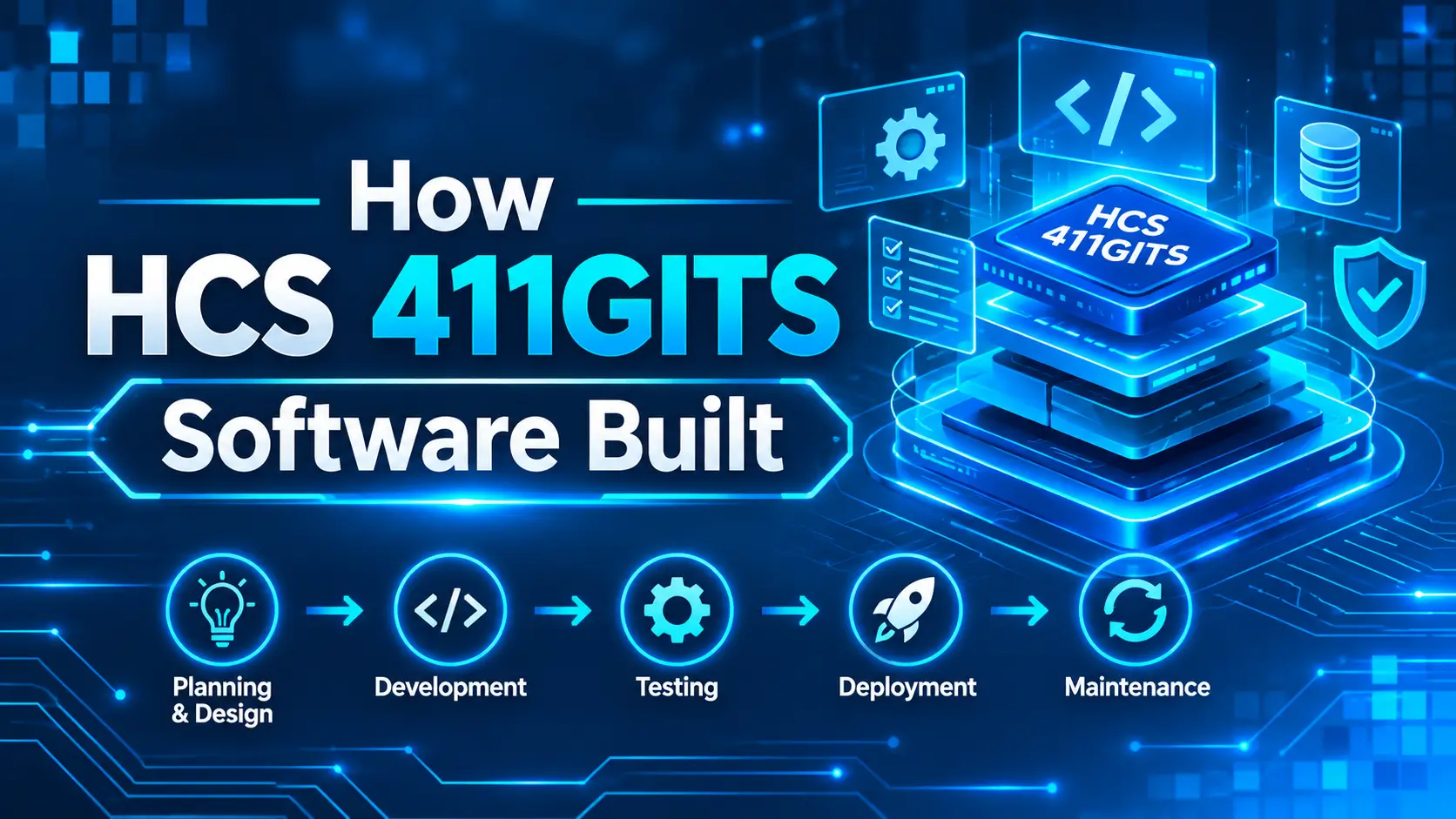
Software development has changed significantly over the years. Applications that once required simple programming and limited computing resources now involve carefully planned architectures, interconnected systems, structured databases, security mechanisms, and continuous updates. Understanding how modern software is designed and developed helps users appreciate the amount of planning and technical work required to create a dependable digital solution.
One search phrase attracting attention in technology-related discussions is how HCS 411GITS software built. People searching for this keyword generally want to understand the development process behind the name, including the technologies, programming methods, architecture, testing procedures, and engineering decisions that could be involved.
However, there is an important distinction between understanding a software development process and claiming knowledge of a particular product’s internal construction. The exact identity and technical specifications of a publicly documented product called HCS 411GITS have not been established through reliable public technical information. Consequently, its original development team, programming languages, database technology, and precise architecture cannot responsibly be presented as confirmed facts.
This guide approaches the subject from a practical software engineering perspective. It explores how a complex software application carrying such a label could be planned, developed, tested, deployed, and maintained. It also explains the engineering concepts readers should understand when evaluating claims about HCS 411GITS.
Rather than assuming that a particular framework or technology was used, the discussion separates general software development practices from product-specific details that remain unverified.
Whether you are a technology enthusiast, software development student, business owner, or someone researching an unfamiliar software name, understanding these principles can help you make better decisions and recognize the difference between genuine technical information and unsupported online claims.
What Is HCS 411GITS Software?
HCS 411GITS is a software-related term that appears in online searches and technology articles. Nevertheless, its precise meaning is not sufficiently established by authoritative public documentation.
This uncertainty is important because a software name does not automatically identify a complete technology platform. A similar-looking name could refer to a private business application, a development project, an internal system identifier, a product abbreviation, or an incorrectly described software release.
The letters and numbers in a technical name may also have different meanings depending on the organization using them. Without an official product description or confirmation from its developer, interpreting each part of the name would involve speculation.
When researching HCS 411GITS, it is therefore useful to consider several possibilities.
First, the term might identify a specialized application developed for a particular organization. Businesses sometimes create proprietary tools that are not distributed publicly. Their source code, design documents, and development history may remain confidential.
Second, it could be an internal technical designation rather than a commercial software name. Development teams frequently use project codes, build numbers, repository labels, and internal identifiers to organize their work.
Third, the phrase might involve confusion with another established software product or technical concept. Similar abbreviations can lead to incorrect assumptions, particularly when articles repeat descriptions without establishing their origins.
The most responsible way to describe HCS 411GITS is to recognize that its exact identity remains unconfirmed. This does not establish that no private system exists under the name. It simply means that its specific technical characteristics should not be invented.
Understanding this distinction provides a useful foundation for exploring how complex software systems are generally developed.
How HCS 411GITS Software Built: Understanding the Development Approach
The development of any substantial software application begins with a problem that needs to be solved. Developers do not normally begin by writing random programming instructions. They first determine the application’s purpose, intended users, expected functions, and operational requirements.
Understanding the different stages of application development can also help readers explore related software-building concepts. Our guide to GDTJ45 Builder Software Code Development provides another perspective on software creation and development.
A disciplined development process generally contains several interconnected stages.
These stages include:
- Identifying the problem and defining project objectives.
- Gathering functional and technical requirements.
- Planning the software architecture.
- Selecting appropriate programming technologies.
- Designing the interface and user experience.
- Developing application logic and data structures.
- Integrating external services where necessary.
- Performing testing and quality assurance.
- Deploying the application into its intended environment.
- Monitoring performance and maintaining the system.
Each stage contributes to the overall quality of the final application.
For example, an application can have a visually attractive interface but still perform poorly if its underlying database is badly designed. Similarly, a technically powerful system may disappoint users when its workflows are confusing or difficult to understand.
Software engineering therefore requires coordination between design, programming, data management, testing, security, and operational planning.
If HCS 411GITS represents a proprietary or specialized application, its actual development process would need to be established through documentation from its owner or development team. The following sections explain the professional methods that could be used when building a comparable application.
1. Planning and Identifying the Software Requirements
Planning is one of the most important stages of software development. Before building an application, developers need a clear understanding of what the system should accomplish and which problems it is expected to address.
A project without a defined purpose can quickly become complicated. Development teams may spend considerable time creating unnecessary features, changing existing functionality, or correcting misunderstandings between stakeholders.
A requirements analysis helps prevent these problems.
During this stage, developers and project stakeholders discuss the intended users, business objectives, essential functions, operating environment, and expected results.
For example, a hypothetical organization planning a digital management application might need a system capable of organizing records, processing user requests, generating reports, and managing access permissions.
These requirements would then be divided into smaller technical tasks.
Functional requirements describe what the application must do. They might include account registration, information processing, data searching, report generation, and administrative controls.
Nonfunctional requirements explain how the application should perform. These include security, reliability, accessibility, response time, availability, and the ability to support future expansion.
Developers can also prepare user stories to understand how different people will interact with the application.
A typical user story might describe how an administrator wants to locate a particular record without manually checking hundreds of entries. Another might explain how an ordinary user needs to update information without receiving administrative privileges.
Requirements planning is particularly important because it gives the development team a reference point for making technical decisions.
Without it, developers may select unsuitable technologies or build features that do not solve the actual problem.
2. Designing the Software Architecture
Software architecture describes how the different parts of an application are organized and how they communicate with one another.
It provides a structural foundation before the development team begins implementing the complete system.
Modern applications can use different architectural approaches depending on their size, responsibilities, performance requirements, and maintenance needs.
One common approach is layered architecture.
In a layered design, responsibilities are divided into separate areas. A typical application may contain a presentation layer, an application logic layer, a data access layer, and a database.
The presentation layer manages what users see and how they interact with the application.
The application layer processes requests, coordinates operations, and applies business rules.
The data access layer manages communication between the application and its stored information.
The database stores the records required by the system.
This separation makes an application easier to understand and maintain because individual responsibilities are not unnecessarily mixed together.
For instance, changing the appearance of a dashboard should not require rewriting the underlying database structure.
Another possible architecture is a modular design. In this approach, developers divide the application into smaller components that perform separate responsibilities.
A module might manage authentication, while another handles reporting and another processes user requests.
The benefit is that developers can improve individual components without repeatedly changing unrelated sections of the application.
Larger applications may also use microservices, where different services operate independently and communicate through defined interfaces.
However, microservices introduce additional responsibilities, including service communication, monitoring, deployment coordination, and failure management.
They are not automatically better than a simpler architecture.
The appropriate structure depends on the actual requirements.
There is no verified public architecture diagram establishing whether HCS 411GITS uses layered architecture, modular architecture, microservices, or another approach. These are examples of established engineering methods rather than confirmed characteristics of the named software.
3. Choosing Appropriate Programming Languages
Programming languages provide the instructions that tell computers how to perform specific operations.
Selecting the right language depends on the application’s purpose, the required performance, integration requirements, development environment, and available technical expertise.
Different languages are suitable for different situations.
Python is commonly used for automation, data processing, scripting, and backend development. Its readable syntax makes it attractive for projects involving data operations and rapid development.
Programming technologies can also introduce performance and compatibility challenges during development. Readers interested in a separate Python-related example can explore our guide to Python SDK25.5a Burn Lag.
Java is widely used for enterprise applications, server-side systems, and applications that require structured programming and established development frameworks.
JavaScript is particularly important for web development because it enables interactive features inside browsers. Combined with server-side technologies, it can also support full-stack applications.
C# is frequently used in business applications and enterprise environments, particularly within the Microsoft ecosystem.
C and C++ are useful in situations where developers require lower-level control, specialized performance, or closer interaction with hardware.
TypeScript adds a stronger type system to JavaScript and is frequently considered for large web development projects.
However, selecting a programming language should not be based simply on popularity.
A language that works well for a small application might not be the ideal choice for a complex system with specialized performance or integration requirements.
Developers also consider:
- The availability of experienced programmers.
- Long-term maintenance requirements.
- Compatibility with existing infrastructure.
- Available libraries and development frameworks.
- Security requirements.
- Performance under expected workloads.
- Deployment and hosting environments.
It would be misleading to state that HCS 411GITS was written in Python, Java, C++, or any other language without an authentic technical record.
The important lesson is that programming language selection should follow the application’s requirements rather than assumptions about a product name.
4. Developing the User Interface
The user interface is the part of a software application through which people interact with its functions.
A well-designed interface makes complex operations easier to understand and reduces the amount of effort required to complete everyday tasks.
Developers and designers usually begin this process by identifying the application’s primary user groups.
Different people may have different needs.
An administrator might require access to system settings, account management, and reporting tools. An ordinary user might only need a dashboard and a small number of frequently used functions.
Trying to provide every user with the same interface can create unnecessary complexity.
Wireframes help organize the interface before developers begin implementing it. These simple layouts show where navigation menus, buttons, forms, dashboards, and information panels should appear.
After the wireframes are reviewed, designers may create prototypes that demonstrate how users move between different screens.
A successful interface should emphasize clarity rather than decoration.
Important design principles include:
Clear navigation: Users should understand where they are and how to reach important functions.
Consistent layouts: Similar features should follow similar design patterns.
Readable information: Text, headings, labels, and instructions should remain understandable.
Useful feedback: Applications should communicate whether an operation succeeded or failed.
Accessibility: People with different abilities should be able to interact with essential functions.
Responsive behavior: Web applications should remain usable across appropriate screen sizes and devices.
Interface development also requires attention to error messages.
A message such as “Something went wrong” does not explain what the user should do next. A better message identifies the problem and provides a reasonable corrective action without exposing sensitive technical information.
The interface is not merely the visual appearance of software. It is an essential part of how people understand and use the system.
5. Building the Backend System
While the frontend provides the user-facing experience, the backend manages many of the operations that make an application function.
Backend development includes application logic, request processing, authentication, data validation, business rules, and communication with databases or external services.
Consider a hypothetical application that allows users to submit information through an online form.
The frontend displays the form and accepts the user’s input. The backend receives that information, verifies that required fields are complete, checks whether the user has permission to perform the operation, and determines how the information should be processed.
If the input is valid, the backend may send the information to a database and return a confirmation to the frontend.
If the input is incorrect, the backend should return an understandable response.
This process requires a carefully organized application structure.
Developers commonly separate responsibilities into controllers, services, business logic components, and data access functions.
Controllers receive incoming requests and determine which application operation should handle them.
Service components perform the relevant operations and coordinate different parts of the system.
Validation rules check whether incoming information satisfies predefined requirements.
Data access components communicate with databases or other storage systems.
This structure can make complicated applications easier to maintain.
Backend development also needs to consider performance. Repeated database queries, inefficient calculations, unnecessary processing, and poorly designed network requests can slow down an application.
Developers use profiling, caching where appropriate, query optimization, and other techniques to identify and correct performance problems.
For a reliable application, backend development should be treated as a central engineering responsibility rather than simply a way to connect the interface to a database.
6. Designing and Managing the Database
Most information-based software applications require a reliable method of storing and retrieving data.
A database provides an organized environment for managing this information.
The correct database structure depends on the type of records being stored, the relationships between those records, the frequency of updates, and the way users access information.
Relational databases organize data into structured tables.
For example, a business management application might maintain separate tables for users, customer records, transactions, and activity history.
Relationships between tables help reduce unnecessary duplication and maintain consistency.
SQL-based database systems are commonly used for structured data management.
Other applications may benefit from document-oriented or other NoSQL databases, particularly when information has flexible structures or different storage requirements.
However, there is no universal rule that one database type is suitable for every project.
Database design normally involves identifying the important data entities, defining their relationships, selecting suitable data types, establishing keys, and considering appropriate indexes.
Data validation is equally important.
An application should not accept incomplete or invalid records when those records could interfere with later operations.
For example, a system managing financial transactions should verify important fields before saving information. An application managing user accounts should avoid storing duplicate account identifiers when uniqueness is required.
Backups also form an essential part of database management.
A backup strategy should define how frequently copies are created, where they are stored, how long they are retained, and how recovery procedures are tested.
Without a tested recovery plan, a backup may provide a false sense of security.
Database performance should also be monitored as the volume of stored information increases.
Slow queries, inefficient indexes, and unnecessary data retrieval can affect the overall performance of an application.
A properly designed database supports accurate information management and helps an application remain dependable over time.
7. Using APIs and Software Integrations
Modern software rarely operates entirely on its own.
Applications often communicate with other systems to exchange information, provide additional functions, or automate workflows.
Application Programming Interfaces, commonly called APIs, provide structured methods for this communication.
An API defines how one application can request information or actions from another.
For example, an internal business application might communicate with an external notification service to send confirmation messages.
A reporting application might receive information from a separate data management platform.
An account management system might use an authentication provider to verify user identities.
APIs help developers connect these services without rebuilding every function from scratch.
However, integration requires planning.
Developers need to understand the API’s authentication requirements, accepted data formats, response structure, rate limits, and potential error conditions.
They must also determine what happens when an external service becomes unavailable.
For instance, an application that depends on an outside notification provider should not necessarily lose access to its core functions when that provider temporarily experiences an outage.
Appropriate error handling, timeouts, retry policies, and logging can make integrations more reliable.
Data exchanged between systems must also be validated.
An application should never assume that every response received from an external service is complete, accurate, or safe to use.
Integration testing is important because individual systems may behave correctly on their own but encounter problems when connected.
Whether HCS 411GITS involves external integrations cannot be confirmed from its name. Nevertheless, API design is an important consideration when developing modern connected applications.
8. Implementing Cybersecurity Measures
Security is one of the most important responsibilities in software development.
Applications may handle personal information, business records, confidential documents, financial data, or other sensitive material.
A security weakness can expose information, interrupt services, or allow unauthorized users to perform actions.
Strong software security also requires effective policies, responsible access management, and employee awareness. Our article on IT security leadership and employee responsibilities explores these organizational considerations in greater detail.
Developers should therefore consider security throughout the development process rather than treating it as a final checklist.
One important requirement is authentication.
Authentication verifies the identity of someone attempting to access an application.
This may involve passwords, approved authentication services, or additional verification methods.
Authorization is a separate process. It determines which operations an authenticated user is allowed to perform.
For example, an administrator may have permission to manage user accounts, while a standard user may only be permitted to view or update their own records.
The principle of least privilege helps reduce unnecessary access by giving users and application components only the permissions required for their responsibilities.
Another essential practice is protecting information during transmission and storage.
Secure communication protocols help prevent unauthorized access to information traveling between connected systems.
Sensitive information should also be handled carefully within databases, application logs, and backups.
Developers need to avoid common security weaknesses such as:
- Improper input validation.
- Weak authentication controls.
- Excessive user permissions.
- Exposed credentials or API keys.
- Insecure database queries.
- Unprotected sensitive information.
- Incorrect configuration of production systems.
- Outdated software dependencies.
Regular security reviews can help identify weaknesses before attackers exploit them.
Developers should also establish a process for handling security incidents.
This includes identifying affected components, limiting damage, investigating the underlying cause, applying corrections, and reviewing whether additional preventive measures are necessary.
Security is not a single feature that can simply be switched on. It is an ongoing responsibility involving architecture, implementation, testing, monitoring, and maintenance.
9. Managing Software Development With Version Control
Software development often involves several people working on the same project.
Without an organized system for managing code changes, teams can overwrite one another’s work, lose important improvements, or struggle to identify when an error was introduced.
Version control helps solve these problems.
Git is one example of a widely used version control system.
It allows developers to record changes, maintain project history, create separate branches, and combine contributions from different team members.
A branch provides an independent development area where programmers can work on a new feature or correction without immediately changing the main codebase.
Once the work is ready, developers can review the changes and merge them into the shared project.
Code reviews are particularly useful because they allow another developer to inspect the changes before they become part of the main application.
A review may identify:
- Incorrect program logic.
- Missing validation.
- Security weaknesses.
- Unnecessary code duplication.
- Performance problems.
- Inadequate error handling.
- Missing automated tests.
Version control also helps development teams return to an earlier working version when a change introduces an unexpected problem.
Importantly, the presence of the word “GITS” in the HCS 411GITS keyword does not establish that the software was developed using Git. These are separate claims that require supporting technical information.
Version control is discussed here because it is an established part of many professional development workflows.
10. Testing and Quality Assurance
Testing determines whether an application behaves as expected under different conditions.
Even carefully written software can contain errors.
A feature may work correctly during ordinary use but fail when users submit unusual information, perform several operations simultaneously, or encounter an unexpected network problem.
Quality assurance helps identify these issues.
Several testing methods serve different purposes.
Identifying and resolving software problems is another important part of maintaining application quality. Our guide on fixing Zenvekeypo4 software issues explores general troubleshooting approaches and possible software problems.
Unit testing examines individual functions or components. A developer might test whether a calculation produces the expected result when given specific inputs.
Integration testing evaluates whether connected components communicate correctly.
Functional testing checks whether application features meet the requirements established during planning.
Performance testing examines how the system behaves under different workloads.
Security testing looks for vulnerabilities, incorrect permissions, and other weaknesses.
Usability testing evaluates whether people can understand and operate the application effectively.
Regression testing checks that new changes have not broken functions that previously worked.
Testing should not be limited to successful situations.
Developers should also examine incorrect inputs, missing information, unexpected responses, network interruptions, expired sessions, and other failure conditions.
For example, consider an application that processes information submitted through a form.
A basic test might confirm that a complete and valid submission is accepted.
Additional tests should examine what happens when a required field is missing, an invalid value is entered, or the user submits the same request repeatedly.
These scenarios help reveal weaknesses that may not appear during ordinary demonstrations.
Automated testing can save time by allowing repetitive checks to run whenever code changes.
Manual testing remains valuable for evaluating complex user experiences and situations that are difficult to describe through automated scripts.
The most dependable approach combines different testing methods according to the project’s risks and requirements.
11. Deploying the Completed Software
Deployment is the process of making an application available in its intended operating environment.
The exact method depends on whether the software is designed for web browsers, desktop computers, mobile devices, private networks, or cloud-based infrastructure.
Before deployment, developers normally prepare a production environment.
This environment should be configured separately from development and testing systems.
The team must consider application settings, database connections, access permissions, network configuration, logging, backups, and security requirements.
A controlled deployment process reduces the possibility of releasing untested changes.
Many teams use continuous integration and continuous delivery practices.
Continuous integration involves automatically checking code changes through processes such as compilation and testing.
Continuous delivery helps prepare validated software for controlled release.
Some organizations automate deployment entirely, while others require an authorized person to approve the final release.
A deployment plan should also include a recovery strategy.
If an update introduces a serious issue, the team may need to reverse the deployment, restore an earlier version, or apply a corrective update.
The objective is not simply to publish software quickly. It is to make the application available in a dependable and controlled manner.
12. Monitoring Performance After Release
The development process does not end when software becomes available to users.
A released application may behave differently under real operating conditions than it did during development.
Users may access it from different devices, networks, locations, and operating environments. Workloads may also increase unexpectedly.
Monitoring helps developers understand how the application behaves after deployment.
Common monitoring areas include:
Response time: How quickly does the system respond to requests?
Availability: Is the application accessible when users need it?
Error rates: How frequently do application operations fail?
Resource usage: Are processors, memory, storage, and network resources being used efficiently?
Database performance: Are queries and transactions completing within acceptable limits?
Security events: Are there unusual login attempts or suspicious activities?
Logs provide another source of information.
They can record important application events, failed operations, system warnings, and technical errors.
However, logs should be designed carefully to avoid exposing passwords, authentication tokens, or other sensitive information.
Monitoring becomes particularly valuable when combined with alerts.
An alert can notify the responsible team when a service becomes unavailable or a significant performance problem develops.
The team can then investigate the issue and take corrective action.
This process helps reduce the time required to recognize and resolve operational problems.
13. Maintaining and Updating Software
Software requires ongoing attention because operating environments, user expectations, security risks, and technical dependencies change over time.
Maintenance involves identifying problems, correcting defects, improving existing features, updating dependencies, and adapting the system to new requirements.
There are several categories of software maintenance.
Corrective maintenance addresses defects discovered after release.
Software updates can sometimes create performance and compatibility challenges. You can also read our guide explaining why Uhoebeans software updates can be slow for another perspective on update-related problems.
Adaptive maintenance modifies the application to remain compatible with changing environments or external systems.
Perfective maintenance improves existing features, usability, or performance.
Preventive maintenance reduces the likelihood of future problems through code improvements, dependency management, and architectural changes.
An effective update process begins with identifying the reason for the change.
A developer might receive a report that a particular operation takes too long. The team would investigate the issue, reproduce it, identify the relevant component, and determine the underlying cause.
After implementing a correction, developers should test the changed functionality and examine whether other parts of the system are affected.
Updates should also be documented.
A release history helps administrators and users understand what changed between versions.
It can include new features, corrections, compatibility adjustments, and known limitations.
Maintenance becomes easier when the original application includes organized source code, clear documentation, automated tests, and a consistent development workflow.
Ignoring maintenance can gradually make software harder to operate and more expensive to improve.
14. Why Software Architecture and Code Quality Matter
The architecture and quality of the underlying code influence how an application performs over time.
A system that is easy to develop initially may become difficult to maintain when its components are poorly organized.
For example, if authentication, database operations, reporting, and interface behavior are all tightly connected, a small change may affect several unrelated functions.
This can increase the time and risk involved in future updates.
Good code quality aims to make software understandable, predictable, and maintainable.
Developers commonly follow principles such as separation of concerns, reusable components, meaningful naming, and consistent coding standards.
Documentation also matters because it helps new developers understand why a system behaves in a particular way.
Code reviews provide another layer of quality control.
Instead of allowing every change to enter the main codebase automatically, teams can examine proposed modifications and identify possible problems.
Technical debt is another important consideration.
Technical debt develops when short-term development decisions create additional work for the future.
For example, skipping important tests might help a team release a feature quickly, but it can make later corrections more difficult.
Not every shortcut is necessarily harmful. The problem occurs when accumulated shortcuts become difficult to manage.
A well-planned architecture does not mean that every application must use complex technologies. In many cases, a simple design with clearly separated responsibilities is easier to maintain and more reliable.
15. How Development Teams Collaborate
Software development is rarely just an individual programming activity.
Larger projects involve people with different responsibilities who work together to create and maintain the application.
A business analyst may collect requirements and translate business needs into technical specifications.
A software architect may plan how the application components should interact.
Frontend developers build the user-facing experience.
Backend developers implement application logic and data processing.
Database specialists help organize storage and data access.
Quality assurance professionals examine application behavior and identify defects.
Security professionals review possible weaknesses.
DevOps or platform engineers manage deployment environments, infrastructure, and operational automation.
Project managers coordinate priorities, deadlines, communication, and resource allocation.
These responsibilities may belong to separate employees in a large organization or be shared among a smaller development team.
The important requirement is clear communication.
Developers should understand what they are building, why each feature matters, and how success will be evaluated.
Regular technical reviews and progress discussions can help identify problems before they become expensive to correct.
Documentation also supports collaboration by recording important decisions.
For example, a developer joining an existing project should be able to understand how the application is organized, how to run tests, and how to prepare a change for review.
A structured workflow reduces dependence on individual employees and helps maintain continuity when team members change.
16. Challenges That Can Affect Software Development
Building reliable software involves more than choosing a programming language and writing code.
Development teams must manage technical, organizational, and operational challenges throughout the project.
One common challenge is changing requirements.
A client or organization may discover new needs after development begins. Some changes may be reasonable, but frequent uncontrolled modifications can increase costs and delay delivery.
Developers can manage this by documenting requested changes and evaluating how they affect the existing system.
Performance is another challenge.
An application that works smoothly with a small amount of information may become slower as the amount of data and number of users increase.
Performance testing and architectural planning can help prevent this problem.
Security requirements also create challenges.
Teams must understand which information needs protection, who should access it, and how sensitive operations should be controlled.
Integration problems can develop when an application depends on an external service with different data formats, availability requirements, or technical limitations.
Legacy systems introduce additional complexity because they may use outdated technologies or undocumented processes.
There is also the challenge of technical communication.
When developers, business stakeholders, and end users interpret requirements differently, the final application may not provide the intended solution.
Some useful practices for managing these challenges include:
- Maintaining clear project documentation.
- Defining requirements before implementation.
- Reviewing architectural decisions regularly.
- Testing important functionality throughout development.
- Monitoring performance after deployment.
- Establishing a process for handling security issues.
- Recording changes and release decisions.
- Collecting feedback from actual users.
Recognizing challenges early allows development teams to make informed decisions rather than repeatedly responding to preventable problems.
17. Hypothetical Case Study One: Building an Internal Business Management Application
The following case study is illustrative. It does not describe a verified HCS 411GITS implementation or an actual company using the software.
Consider a medium-sized organization that manages customer information, internal requests, and operational reports through several disconnected tools.
Employees regularly transfer information between spreadsheets, email conversations, and separate applications.
This creates unnecessary work and makes it difficult to maintain consistent records.
The organization decides to investigate the development of a centralized software application.
The first step is understanding the existing workflow.
Developers and business representatives identify which activities consume the most time and where information is commonly lost or duplicated.
They then establish the main requirements for the proposed application.
The system needs user accounts, access permissions, record management, searching, reporting, and an administrative dashboard.
The development team plans a modular architecture.
The authentication component manages account access. A records component stores and organizes information. A reporting component produces summaries, while the dashboard provides users with a consistent interface.
Database planning focuses on maintaining accurate records and avoiding unnecessary duplication.
Frontend developers build the primary screens using wireframes and prototypes.
Backend developers implement the business rules and connect the application to the database.
After the first working version is ready, the quality assurance team tests different workflows.
They examine account permissions, incomplete form submissions, duplicate records, and report generation.
The application is then introduced through a controlled rollout.
Employees receive instructions, administrators monitor the system, and developers review feedback.
Several improvements may follow, including better search functionality, clearer error messages, and more efficient reporting.
This example shows how requirements, architecture, programming, databases, testing, and maintenance fit together in a real-world software development scenario.
The same general engineering principles can be applied to many types of applications, although the precise requirements and implementation decisions will differ.
18. Hypothetical Case Study Two: Developing a Data-Heavy Analytical Application
The second illustrative case study focuses on an application that processes large amounts of information and produces reports for professional users.
Imagine a research organization that receives information from multiple internal sources.
Employees need to combine the information, identify patterns, perform calculations, and generate reports.
Manual processing creates delays and increases the possibility of inconsistent results.
The organization decides to develop a centralized analytical application.
The project begins with requirements gathering.
The team identifies which data sources must be supported, which calculations are required, and how users should access the results.
The architecture is planned around separate components for information ingestion, validation, processing, storage, and reporting.
An ingestion component receives information from approved sources.
A validation component checks whether the incoming records meet the required format and quality standards.
The processing component performs the necessary calculations.
The database stores the information and associated results, while the reporting component prepares information for users.
Testing focuses on accuracy and reliability.
Developers create test datasets that include ordinary records, missing values, unusual inputs, and other conditions that could affect calculations.
They compare expected outcomes with application results and investigate any differences.
Performance testing examines how the application behaves when processing larger workloads.
Security reviews ensure that confidential information is accessible only to authorized users.
After deployment, the team monitors processing times, error messages, storage usage, and user feedback.
Over time, the organization may introduce additional data sources or improve reporting functions.
This example demonstrates why analytical applications need careful attention to data validation, processing logic, testing, and performance.
It also shows why a development article should avoid casually assigning a particular programming language or database to a named system without reliable evidence.
19. How to Evaluate Claims About HCS 411GITS
When an unfamiliar software name appears online, readers may encounter articles describing its developer, architecture, capabilities, updates, and technical specifications.
The challenge is determining which details are actually supported.
A reliable evaluation begins with product identification.
Understanding whether software is open source or proprietary is another important consideration when evaluating a technology product. You can explore this subject further in our article about Mogothrow77 software and open-source availability.
Look for an official website, publisher information, recognizable product documentation, licensing details, and a clearly identified support channel.
If a developer claims that a particular programming language was used, look for technical documentation or an authentic statement that supports the claim.
If an article describes a specific release, check whether the publisher maintains a version history or release notes.
If someone claims that the software includes artificial intelligence, cloud integration, or automated processing, look for a product specification demonstrating that capability.
There is a difference between a feature that could reasonably be implemented and one that has actually been implemented.
For example, a developer could build a software application using Python and a relational database. That does not establish that an unfamiliar product uses those technologies.
The same principle applies to Git, cloud hosting, microservices, machine learning, and other technical concepts.
A practical verification checklist includes:
- Does an identifiable publisher own or distribute the software?
- Is there an official product description?
- Can the software’s intended purpose be established?
- Are technical specifications available?
- Is there a reliable version history?
- Can the development team or organization be identified?
- Are installation instructions published through a trusted channel?
- Are claimed features explained in actual product documentation?
- Is there a legitimate support or contact process?
- Do independent technical descriptions agree with the official information?
Not every private or enterprise application will have public documentation. Confidential projects may not publish their source code or architecture.
However, that does not make unsupported online claims reliable.
When evidence is unavailable, acknowledging uncertainty is more useful than presenting guesses as technical facts.
20. The Role of Artificial Intelligence in Modern Software Development
Artificial intelligence has introduced additional possibilities for modern software development.
Developers can use AI-based tools to assist with code suggestions, documentation, test generation, error investigation, and information analysis.
Some applications also integrate AI capabilities into their actual user-facing features.
For example, an application might include an intelligent search assistant, automated classification, document analysis, or a system that helps users organize information.
However, AI should be introduced only when it solves a genuine problem.
Adding an AI component simply because the technology is popular can make software more complicated without improving its usefulness.
AI-generated code also requires careful review.
Developers must examine the output for correctness, security, maintainability, and compatibility with the existing application.
AI-generated responses can be incorrect or incomplete, particularly when the tool does not understand the entire development environment.
Organizations must also consider data privacy before sending confidential information to external AI services.
Another important issue is transparency.
Users should understand when an application uses automated decisions or generates recommendations that may affect their work.
Testing is particularly important when AI functionality is involved because outputs may vary according to input information and operating conditions.
Although artificial intelligence may play a role in future software projects, there is no verified basis for claiming that HCS 411GITS specifically contains AI functionality.
The broader lesson is that technology choices should be based on clear requirements, measurable benefits, and appropriate safeguards.
21. What Makes Software Reliable in the Long Term?
A successful software application is not defined only by its initial release.
Long-term reliability depends on whether the system can continue operating effectively, adapt to changing needs, and remain manageable as its environment develops.
One important factor is maintainability.
Developers should be able to understand the code, identify problems, and implement corrections without creating unnecessary disruption.
Scalability is another consideration.
An application should be designed with a reasonable understanding of how its workload may develop.
Scalability does not necessarily mean building an extremely large infrastructure from the beginning. It means making technical decisions that do not create unnecessary barriers to future growth.
Security must also remain a continuous priority.
Dependencies should be reviewed, access permissions should be monitored, and vulnerabilities should be addressed through an established maintenance process.
Documentation contributes to reliability by explaining how the system works and how important operations should be performed.
User feedback is equally valuable.
People who interact with an application regularly may identify usability problems or missing functions that were not obvious during initial development.
A practical improvement process collects this feedback, evaluates its importance, and introduces changes in a controlled manner.
Monitoring and incident management also matter.
A development team should know how to identify system problems, investigate their causes, communicate important issues, and restore normal operations.
These practices help software remain useful beyond its initial development stage.
22. Common Misunderstandings About Software Development
Software development is frequently misunderstood because people often focus on visible features rather than the engineering work behind them.
One common misunderstanding is that building software simply means writing code.
Programming is important, but a successful application also needs planning, design, data management, security, testing, and maintenance.
Another misunderstanding is that the newest programming language automatically produces better software.
The quality of a solution depends on how effectively the selected technology meets the project’s requirements.
A different misconception is that more complicated architecture always means better engineering.
A small application may work perfectly well with a straightforward design. Adding unnecessary services and infrastructure can increase maintenance responsibilities.
Some people also assume that a released application is finished.
In reality, user feedback, security updates, compatibility adjustments, and changing requirements can require continuous improvement.
There is also a tendency to confuse technical possibilities with confirmed product capabilities.
An article might explain how developers could use artificial intelligence, databases, or cloud computing to build a system. That explanation does not prove that a particular named product contains those features.
Understanding these differences makes software discussions more informative and reduces confusion.
23. Future Considerations for Software Development
Software engineering continues to develop as hardware, programming tools, business requirements, and user expectations change.
Several broader trends are influencing how developers plan future applications.
Cloud infrastructure provides organizations with options for hosting applications and managing computing resources without maintaining every component on their own premises.
Containerization can help make software environments more consistent between development and production.
Automation can reduce repetitive operational work and improve the reliability of testing and deployment procedures.
Improved accessibility practices are encouraging developers to make applications easier to use for people with different abilities.
Data protection and security engineering are receiving greater attention as applications increasingly connect services and manage confidential information.
Artificial intelligence is also influencing how developers approach programming support, data analysis, and application functionality.
Another important direction is interoperability.
Organizations often use several applications that need to exchange information. Better integration can reduce repeated data entry and improve workflow consistency.
However, future development should not be reduced to following technology trends.
The best technical solution is still the one that addresses real user requirements while remaining secure, maintainable, and practical.
For any software project identified as HCS 411GITS, a reliable understanding of its future would require confirmation of its actual identity, ownership, purpose, and development roadmap.
Until that information is available, broader technology trends should be understood as possibilities for modern applications rather than confirmed product plans.
Frequently Asked Questions About How HCS 411GITS Software Built
1. How HCS 411GITS software built?
The exact development history of a verified product under the HCS 411GITS name has not been established through authoritative public technical documentation. Generally, complex software applications are built through requirements gathering, architecture planning, programming, database design, testing, deployment, and continued maintenance. These stages provide a practical framework for understanding how comparable software systems are developed.
2. What is HCS 411GITS software?
HCS 411GITS is a software-related search term, but its precise identity remains unclear. There is insufficient verified information to establish its official developer, purpose, technical architecture, or product history. It is important to distinguish the term from other established software products with similar abbreviations.
3. Which programming language was used to build HCS 411GITS?
No reliable public technical specification has confirmed the programming language used for HCS 411GITS. Software developers commonly use languages such as Python, Java, JavaScript, C#, and C++ depending on the application’s requirements. However, these are general examples and should not be treated as confirmed technologies behind this particular name.
4. What technology is required to build modern software?
Modern software development may involve programming languages, development frameworks, databases, APIs, version control systems, testing tools, and deployment infrastructure. The specific technology selection depends on the application’s purpose, expected workload, security requirements, and operating environment.
5. Is HCS 411GITS connected with Git?
There is no verified public technical information establishing that HCS 411GITS was developed using Git. Git is a widely used version control system that helps developers track code changes and collaborate on software projects. Similarity between a product name and a technical term does not establish a connection.
6. Does HCS 411GITS use artificial intelligence?
Its AI capabilities have not been verified through authoritative product documentation. AI can be integrated into modern applications for automation, information analysis, intelligent search, and other functions. However, those possibilities should not be presented as confirmed HCS 411GITS features.
7. How important is database design in software development?
Database design is essential because it determines how an application stores, organizes, retrieves, and updates information. A properly designed database helps maintain consistency, supports efficient queries, and makes future development easier. Poor database design can lead to duplicated records, slower performance, and data management problems.
8. How do developers make software secure?
Developers use several methods, including secure authentication, authorization controls, input validation, protected communication, careful data handling, dependency updates, and security testing. Regular monitoring and maintenance are also necessary because new vulnerabilities and operational risks can emerge after an application is released.
9. Why is software testing important?
Software testing helps identify errors before they affect users. It checks whether features work correctly, whether connected components communicate properly, and whether an application remains dependable under different operating conditions. Effective testing also helps protect existing functionality when developers introduce updates.
10. Can HCS 411GITS be downloaded?
A verified official download source for software under the exact HCS 411GITS name has not been established. Before installing any unfamiliar application, users should confirm its publisher, official website, licensing information, and installation instructions. Downloading files from unidentified websites can introduce unnecessary security risks.
11. What is the difference between frontend and backend development?
Frontend development focuses on the parts of an application users interact with, including screens, buttons, navigation, and forms. Backend development manages application logic, information processing, database communication, authentication, and other operations behind the interface. Both areas work together to create a complete software application.
12. What is the role of APIs in software development?
APIs allow different software applications and services to exchange information through defined communication methods. They can support integrations such as notifications, authentication, payment processing, and external data access. Proper API design helps developers connect systems while managing security, performance, and compatibility.
13. How often should software be updated?
Software updates should follow the application’s security requirements, maintenance schedule, dependencies, and operational needs. Critical security problems may require urgent corrections, while other changes can be introduced through planned releases. Updates should be tested before deployment to reduce the risk of introducing new errors.
14. What is the role of version control in software development?
Version control allows developers to track changes to source code and collaborate without losing important project history. Systems such as Git support branching, merging, code reviews, and recovery of previous versions. These functions make collaborative development more organized and manageable.
15. Can software be improved after its initial release?
Yes. Software can be improved through maintenance, performance optimization, security updates, interface improvements, new features, and compatibility adjustments. Developers also use user feedback and monitoring information to identify areas that require attention. Continuous improvement helps an application remain useful as requirements change.
16. Why is HCS 411GITS difficult to research?
The exact product identity and its official technical documentation are not clearly established in publicly verifiable information. Several general software development concepts may appear in articles discussing the keyword, but those concepts do not confirm the product’s actual features or architecture. Reliable identification requires information from the software’s owner or developer.
Conclusion
Understanding how software is built requires looking beyond its name and examining the engineering processes that make modern applications work.
A reliable software development project begins with clear requirements and continues through architecture planning, programming, interface design, database management, integration, security, testing, deployment, and maintenance.
Each stage contributes to the final application’s usability, performance, reliability, and long-term value.
The keyword how HCS 411GITS software built raises questions about programming technologies, system architecture, development methods, and technical implementation. However, the exact product identity and internal development history associated with that name remain unverified. Therefore, specific claims about its developers, programming languages, databases, or advanced features should not be treated as established facts without proper documentation.
What can be explained confidently is how comparable software applications are designed and developed using established software engineering practices.
For readers researching HCS 411GITS, the most useful approach is to distinguish confirmed product information from general technical explanations. This helps create a more accurate understanding of unfamiliar software while avoiding unnecessary assumptions.
Ultimately, successful software development depends on solving real problems, selecting appropriate technologies, maintaining strong security, testing functionality carefully, and improving the application throughout its operational life.
For More Visits: Bright Magazine
