

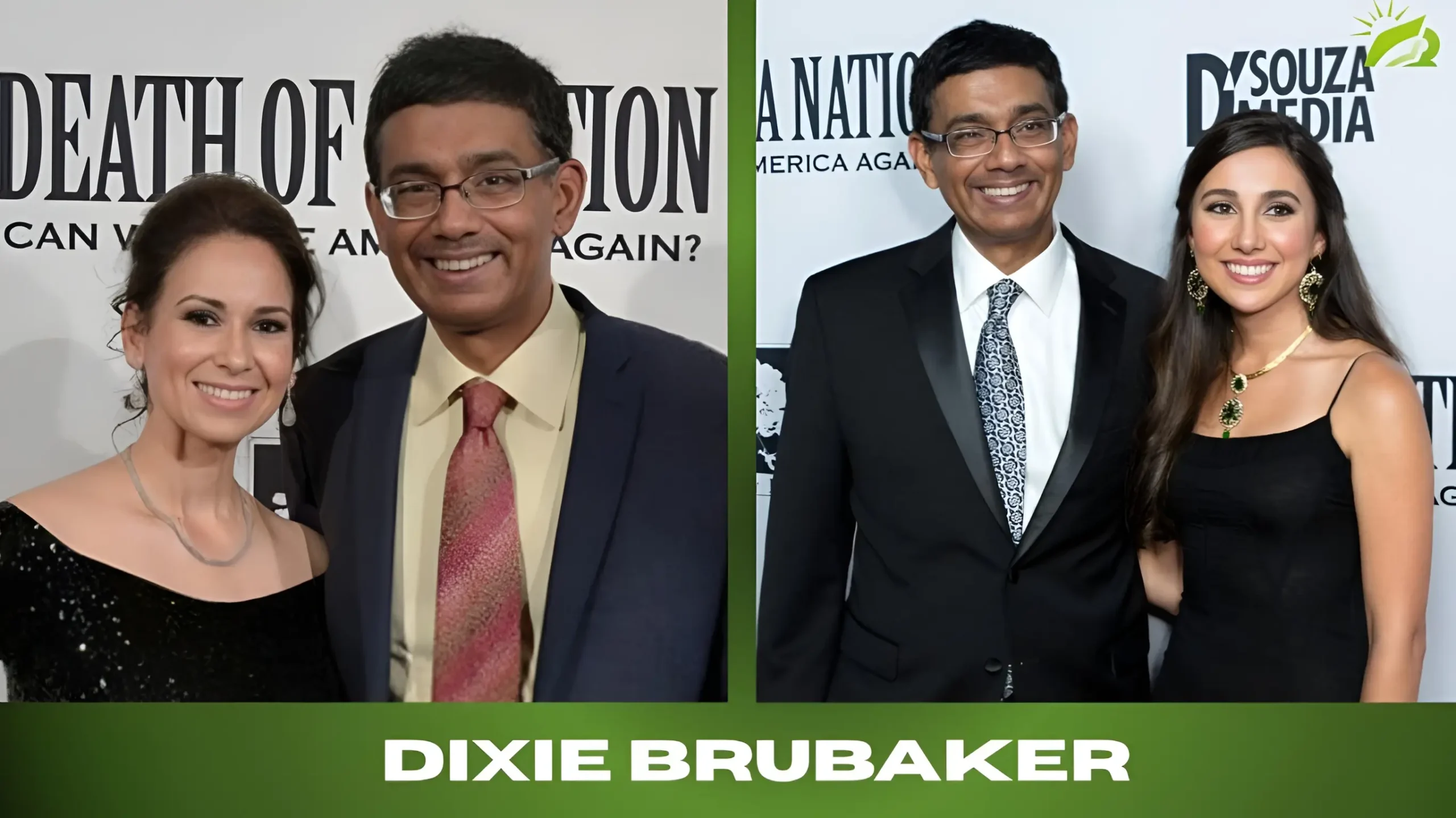
Dixie Brubaker is a name that frequently appears in searches related to Dinesh D’Souza, the American conservative author, political commentator, and filmmaker. Although D’Souza has spent decades attracting public attention through his books, documentaries, and political commentary, Brubaker has maintained a much more limited public profile. This contrast has made people curious about her background, family, marriage, and life away from the spotlight.
Interest in Dixie Brubaker is closely connected to her relationship with D’Souza, whom she married in 1992. Their marriage lasted for more than two decades before the relationship formally ended in divorce proceedings in 2012. The couple also had a daughter, Danielle, who later developed a public profile of her own. These connections provide the most reliable starting points for understanding Brubaker’s place in the wider family story.
However, researching a person whose public presence is limited requires care. Online biographies sometimes present precise details about age, professional achievements, finances, and present-day circumstances without explaining how those claims were established. A responsible biography must distinguish between documented information and details that remain unavailable.
This article explores Dixie Brubaker’s publicly documented background, her connection with Dinesh D’Souza, their marriage and family, the events surrounding their separation, and the reasons her name continues to attract online interest. It also examines what can reasonably be understood from the available record without turning unanswered questions into unsupported claims.
Who Is Dixie Brubaker?
Dixie Brubaker is best known publicly as the former wife of Dinesh D’Souza. Before and during their marriage, she was connected to Washington’s political environment, where D’Souza was beginning to establish his reputation as a conservative writer and commentator.
A contemporary report published by The Washington Post in April 1992 identified Brubaker as an intern in the White House Office of Political Affairs. The same report described her as attending graduate school while preparing for her upcoming wedding to D’Souza. This provides an important glimpse into her life during the period immediately before their marriage.
Beyond these details, the available public record is comparatively limited. Unlike people who build careers through entertainment, politics, business, or journalism, Brubaker has not established a similarly extensive public record under her own name. Consequently, many aspects of her personal and professional background remain difficult to confirm.
Her public identity is therefore closely associated with three subjects: her early connection to Washington politics, her marriage to D’Souza, and her relationship with their daughter. These are the areas in which reliable information provides the clearest picture of her life.
Understanding this distinction is essential. A person’s connection to a prominent public figure can make that person a subject of curiosity, but it does not mean every aspect of their personal history is publicly documented. In Brubaker’s case, a fact-based biography must acknowledge both what is known and where the available information ends.
Early Life and Background
One of the most common questions about Dixie Brubaker concerns her early life. Readers often want to know where she grew up, what her family was like, which schools she attended, and what ambitions she had before becoming associated with a well-known political commentator.
Unfortunately, dependable public information about these subjects is limited. There is no consistently documented account of her childhood that provides a complete picture of her upbringing, family relationships, or early aspirations. Specific claims about her birthplace, date of birth, or childhood experiences should therefore be treated cautiously unless supported by a reliable record.
What can be established is that Brubaker was involved in Washington’s political environment by the early 1990s. Her reported internship in the White House Office of Political Affairs placed her in a professional setting connected to the federal government’s political operations. Her graduate studies also indicate that education was part of her life during that period.
These details offer a starting point without requiring assumptions about her private background. They show that her life before marriage included an educational commitment and an association with political work, even though the subject of her studies and the full extent of her professional responsibilities are not clearly established in the public record.
It is tempting to fill these gaps with a conventional biography that describes childhood influences, family values, personal ambitions, or formative experiences. Yet such details are meaningful only when they are supported by evidence. Without reliable documentation, they would create an impression of knowledge that the available record does not justify.
The most responsible conclusion is that Brubaker’s early years remain largely private. Readers can understand the broad context in which she became publicly known, but a comprehensive account of her childhood and education would require additional verified information.
Dixie Brubaker’s Connection to Washington Politics
Washington, D.C., provides an important setting for understanding how Dixie Brubaker became associated with Dinesh D’Souza. During the late 1980s and early 1990s, Washington brought together political staff members, policy specialists, journalists, academics, and aspiring writers. The city offered an environment in which professional and personal relationships could develop around shared political interests.
At the time, D’Souza was building his career as a conservative writer. His work attracted attention through his commentary on American politics, public institutions, and cultural debates. A 1992 Washington Post report described him as a former domestic policy analyst in the Reagan White House who had become an emerging author.
Brubaker’s reported role as an intern in the Office of Political Affairs placed her in the same broad political environment. This context helps explain their connection without suggesting that every aspect of their relationship was determined by their professional surroundings.
Political work can expose people to a broad network of colleagues and acquaintances. Shared workplaces, professional ambitions, and overlapping interests often create opportunities for relationships to develop. In Brubaker’s case, contemporary reporting provides a direct connection between the White House environment and the beginning of her relationship with D’Souza.
Her own political beliefs and long-term professional goals, however, should not be inferred solely from her internship or her later marriage. Working in a political office does not establish a person’s complete ideological identity, and being married to a commentator does not necessarily mean sharing every public position that commentator expresses.
The Washington connection matters because it is one of the better-documented elements of Brubaker’s early public story. It supplies historical context for her relationship with D’Souza while leaving room for the distinction between their individual lives.
How Dixie Brubaker Met Dinesh D’Souza
The beginning of Dixie Brubaker’s relationship with Dinesh D’Souza is one of the few aspects of her personal history described in contemporary reporting.
In an April 1992 article, The Washington Post recounted how Brubaker sought out D’Souza after hearing that he was working nearby. The account described their first encounter in the White House workplace and presented it as the beginning of a relationship that developed toward marriage. According to the report, the couple were planning a May wedding that year.
This account is useful because it appeared at the time of their relationship rather than decades later, when online biographies began revisiting their personal history. Contemporary coverage can provide valuable historical context, especially when later articles repeat information without identifying its origin.
D’Souza was already establishing himself as a writer and political thinker. His book Illiberal Education had attracted attention in debates about race, sex, and American universities. Brubaker, meanwhile, was attending graduate school and working as an intern. Their respective activities placed them in a professional environment where politics, writing, and public affairs were important parts of daily life.
The available reporting offers an outline of how the relationship began, but it does not establish every detail of their courtship. There is no need to invent private conversations, romantic milestones, or personal motivations to make the story interesting.
The documented account is sufficient to explain the public significance of their meeting. It connected Brubaker to a person whose career would later become much more visible, bringing her name into news coverage and biographical discussions that extended far beyond their original Washington setting.
Their marriage followed soon afterward, marking the beginning of a family relationship that would remain part of D’Souza’s public biography for decades.
Dixie Brubaker and Dinesh D’Souza’s Marriage
Dixie Brubaker and Dinesh D’Souza married in May 1992. Their wedding was reported in The Washington Post shortly after the ceremony, confirming the marriage that had been anticipated in earlier coverage.
At the time, D’Souza was developing a career through books, political commentary, public speaking, and later filmmaking. Over the years, his professional activities became increasingly visible. His writing and documentaries attracted audiences, supporters, and critics, making his personal history more likely to appear in media profiles.
Brubaker occupied a different position. Although her marriage linked her to a prominent public commentator, she did not develop a comparably extensive public profile. As a result, most accounts of their relationship concentrate on the marriage itself and the major events that later brought it into the public record.
The distinction between their public lives is important. A person may share a household and family history with a public figure while remaining largely outside that person’s professional world. Public coverage of one spouse does not automatically provide a complete or balanced account of the other.
The available record confirms that their marriage lasted for more than 20 years before D’Souza filed for divorce in October 2012. Their relationship also included the experience of raising a daughter, making family life a significant part of the history connecting them.
It is not possible to reconstruct the full private experience of their marriage from the limited information available. General statements about their happiness, disagreements, personal sacrifices, or day-to-day routines would require evidence that has not been established in the public record.
A careful account can nevertheless recognize that their marriage formed a substantial part of Brubaker’s documented adult life. It also explains why searches for her name often lead readers to articles about D’Souza rather than to independent profiles devoted to her own career.
Family Life and Motherhood
Family is one of the central subjects in discussions of Dixie Brubaker. She and Dinesh D’Souza had one daughter, Danielle, during their marriage. Their daughter later became a public figure in her own right, creating another point of connection between Brubaker’s private family history and wider public life.
The existence of their daughter is established in biographical accounts and in the record of the couple’s divorce proceedings. A California Court of Appeal opinion concerning the marriage dissolution identifies one daughter and discusses the proceedings that followed the couple’s separation.
Beyond those basic facts, however, publicly available information provides limited insight into Brubaker’s day-to-day experience as a mother. Details about household routines, parenting decisions, family traditions, and private conversations are not reliably established through the available reporting.
It would therefore be inappropriate to attribute a specific parenting style or a set of personal beliefs to Brubaker without supporting evidence. Parenthood is often an important part of a person’s life, but outsiders cannot reconstruct an individual family’s private dynamics simply by reviewing the public careers of its members.
What can be said is that Brubaker’s relationship with Danielle forms a continuing part of her known family history. Danielle’s later public activities have also renewed interest in the family connection, leading readers to search for more information about her parents.
This interest should not be confused with proof that Brubaker wishes to participate in public debate or media coverage. Her daughter’s public profile and her former husband’s professional visibility are separate from any unverified assumptions about Brubaker’s own intentions.
Family history can help readers understand why a name appears in public records, but it should not be used as a substitute for a person’s individual biography. In this case, motherhood is a confirmed part of Brubaker’s story, while many details about her personal experience remain private.
Why Dixie Brubaker Has a Limited Public Profile
A major reason Dixie Brubaker attracts curiosity is the difference between the amount of attention surrounding her name and the relatively small amount of dependable information about her own life.
D’Souza’s career has included books, documentaries, public commentary, and appearances in political discussions. These activities naturally produce interviews, reviews, profiles, and historical accounts. As a result, his professional life has been documented far more extensively than that of someone who has not maintained the same kind of public-facing career.
Brubaker’s name appears within this larger story, but that does not mean she has the same relationship with public attention. There is no consistently documented body of interviews, autobiographical writing, or public statements that provides a comprehensive account of her views or personal circumstances.
The absence of extensive coverage can create a problem for online researchers. When readers expect to find the same level of detail available for a celebrity or elected official, they may encounter websites that attempt to fill every gap with statements about age, occupation, residence, finances, or personality.
Those claims may sound plausible, especially when presented in a confident tone. However, confidence in writing is not evidence that the information is correct.
Brubaker’s limited profile should be understood as a limitation of the available public record, rather than as evidence of a hidden narrative. There is no reason to assume that every person connected to a high-profile family has secret ambitions, dramatic personal experiences, or an undisclosed career.
The most informative approach is to separate established facts from unanswered questions. Doing so allows readers to understand her known connection to D’Souza while respecting the boundary between public information and personal privacy.
Dixie Brubaker and the Divorce Timeline
The end of Dixie Brubaker’s marriage to Dinesh D’Souza is a significant part of her publicly documented history. Understanding the timeline requires distinguishing between the period when the couple began living primarily apart and the later legal date of separation.
According to a California Court of Appeal opinion issued in August 2020, the couple married in May 1992 and began living primarily apart in August 2010. D’Souza filed for divorce in October 2012, and October 3, 2012, was later determined to be the legal date of separation in the proceedings.
These dates illustrate why different accounts sometimes appear to describe the separation differently. A relationship may change in practice before a formal legal process begins, while courts may determine a legal separation date for purposes connected with property, support, and other matters.
The divorce was not limited to a simple filing followed by an immediate final order. The appellate record describes subsequent proceedings concerning unresolved issues in the marriage dissolution, including financial matters and legal requests made by both sides.
Those proceedings continued for several years. In 2020, the California Court of Appeal reviewed judgments arising from the case and affirmed them. The opinion identifies itself as unpublished, a distinction that matters when interpreting its legal status.
It is possible to discuss this documented timeline without speculating about the private reasons the marriage ended. Claims about personal motivations, emotional experiences, or the complete circumstances behind a separation require more than a list of dates.
The distinction between personal history and legal history is especially important here. The marriage and divorce are public facts, but not every aspect of the relationship is explained by the court record.
For readers seeking a basic answer, the essential timeline is clear: Brubaker and D’Souza married in 1992, began living primarily apart in 2010, and entered divorce proceedings in 2012. The later litigation addressed issues that remained unresolved after the initial filing.
The Legal Proceedings and Public Record
Dixie Brubaker’s divorce proceedings are among the most detailed sources of publicly available information about her later years of marriage. Court records can establish dates, describe the issues that were considered, and explain how a legal dispute progressed through the judicial system.
In the Brubaker and D’Souza case, the California Court of Appeal reviewed judgments involving property division, spousal support, and other issues connected with the dissolution of their marriage. The opinion describes a lengthy process involving multiple stages of proceedings and later appeals.
This legal history provides context for the fact that the divorce attracted continuing attention long after the initial filing. For people researching Brubaker, the case also supplies some of the clearer documented facts about the length of the marriage and the timing of the separation.
However, legal documents should not be treated as complete biographies. Their purpose is to address questions presented to a court, rather than to describe every aspect of a person’s life. A document may provide detailed information about a financial dispute while revealing little about a person’s interests, professional activities, or private relationships outside the issues before the court.
It is also important to distinguish an allegation made during litigation from a judicial finding. The fact that a person makes a claim does not establish that the claim was proven. Similarly, an appellate court’s decision on a particular legal issue should not be presented as a judgment about every aspect of the people involved.
A careful reader should identify who made a claim, what the court was asked to decide, and what the court ultimately ruled. This approach is particularly useful when different websites summarize the same dispute in dramatically different language.
The 2020 appellate opinion itself states that it was not published in the official reports. That status should be respected rather than ignored or misrepresented.
For a biography of Dixie Brubaker, the proceedings are relevant because they establish part of the marriage’s later history. They should not become an excuse to speculate about her character, private motivations, or personal life beyond what the record actually supports.
What the Public Record Does-and Does Not-Reveal
Public records can make a biography more accurate, but they also have limits. This distinction is particularly important when writing about Dixie Brubaker because so much online interest centres on information that is not independently established.
The available documentation supports several broad conclusions. Brubaker worked as an intern in Washington’s political environment, was attending graduate school in 1992, married Dinesh D’Souza that year, had one daughter with him, and later became involved in divorce proceedings that continued for years.
These facts form a reliable foundation for an introductory biography. They provide a chronological structure and explain the central relationships associated with her name.
Other questions remain unresolved in the sources reviewed for this article. A reliably confirmed date of birth, a complete professional history after her early Washington connection, her present occupation, and her current residence are not established by the principal historical sources discussed here.
The absence of confirmation is not an invitation to guess. A biography that gives a precise age or net worth without a credible basis may appear informative at first glance, but it risks misleading readers and damaging the publication’s credibility.
A useful distinction is between a fact that has been confirmed and a claim that merely appears on multiple websites. Several pages may repeat the same detail without offering independent evidence. Repetition alone does not establish that the original claim was accurate.
Responsible writing also avoids assigning motives. Brubaker’s limited public visibility does not prove why she stays out of interviews or whether she deliberately avoids particular subjects. Unless she has publicly explained those decisions, the most accurate description is simply that substantial information about her present life is not readily available in reliable reporting.
This approach may produce a less dramatic article than a speculative profile, but it gives readers a clearer understanding of the difference between knowledge and assumption.
Who Is Danielle, Dixie Brubaker’s Daughter?
Danielle D’Souza Gill is an important part of the family history associated with Dixie Brubaker. She is the daughter of Brubaker and Dinesh D’Souza, and she later developed a more visible public profile than her mother.
Danielle has been associated with writing, political commentary, and media projects. Her activities have led readers interested in the wider D’Souza family to seek information about both parents, including Brubaker.
This family connection helps explain why Brubaker’s name continues to appear in search results even though information about her individual career is limited. People frequently research the backgrounds of public personalities, their parents, spouses, children, and other relatives to understand how family relationships intersect with public life.
Nevertheless, Danielle’s professional path should be distinguished from her mother’s story. The fact that a daughter participates in public commentary does not establish that her mother has the same interests, career plans, or political priorities.
Similarly, details about Danielle’s public activities do not provide automatic evidence about Brubaker’s present circumstances. Family members can lead very different lives and may have different attitudes toward privacy and media attention.
For a biographical article, the relevant and confirmed point is the parent-child relationship. Additional details should be included only when they are accurate, relevant to the subject, and supported by trustworthy information.
This distinction is particularly valuable when readers search phrases such as “Dixie Brubaker daughter” or “Dixie Brubaker family.” It answers the basic question without turning a family relationship into speculation about private experiences.
Brubaker’s place in the family story is established through motherhood and her former marriage. Her daughter’s public career provides context for continuing interest in the family’s history, but it does not eliminate the need to respect the boundaries of Brubaker’s own public record.
Dixie Brubaker’s Life After Divorce
Readers often search for information about Dixie Brubaker today. They want to know whether she has continued working, where she lives, whether she has remarried, and what her daily life looks like after the end of her marriage.
These are understandable questions, but dependable public information does not establish a complete account of her present circumstances. The records that provide the clearest historical details are largely concerned with her relationship with D’Souza, their family, and the legal proceedings that followed the marriage.
They do not provide a verified, current biography covering every subsequent year. As a result, claims about Brubaker’s present occupation, relationship status, residence, or everyday activities should be treated cautiously unless credible, direct evidence is available.
It is important not to confuse a lack of recent coverage with a lack of activity. People may pursue careers, family responsibilities, education, business interests, or personal goals without discussing those activities publicly. Equally, there is no reason to invent an ongoing career or a particular lifestyle when the evidence does not establish one.
A reliable biography can acknowledge that the public record becomes less informative after the divorce proceedings. It does not need to manufacture a detailed later-life narrative to appear complete.
This is also where readers should be cautious about articles that promise to reveal her “current lifestyle” or “secret life” but supply little verifiable information. Such headlines may create expectations that the material cannot satisfy.
The most responsible answer is straightforward: Dixie Brubaker remains a comparatively private individual in the available public record, and many specific details about her life after divorce are not reliably confirmed by the sources reviewed here.
As new, trustworthy information becomes available, her biography may be updated. Until then, distinguishing known facts from unknown details offers a more meaningful account than presenting unsupported claims as established truth.
Why People Continue Searching for Dixie Brubaker
Online interest in Dixie Brubaker can be understood through the way people research public figures and their families. When someone becomes associated with a prominent author or political commentator, their name may continue appearing in news coverage, biographies, historical articles, and search suggestions long after a particular event has passed.
D’Souza’s career has provided a continuing reason for readers to examine his personal history. People who discover his books, films, political commentary, or public controversies may also become interested in his first marriage and family background.
Brubaker’s name then becomes part of a wider search journey. Someone looking for information about D’Souza may ask who he married, when the marriage ended, whether the couple had children, and what happened afterward. Each question can lead to another search involving Brubaker.
There is also a broader curiosity about the relatives of well-known people. Readers often want to understand the family circumstances behind a public figure’s career, even when the relatives themselves have not sought extensive publicity.
Search interest, however, should not be mistaken for evidence that every detail about a person’s life belongs in the public domain. Nor does the frequency of a question make an unsupported answer reliable.
A useful biography responds to genuine reader questions in a measured way. It explains Brubaker’s documented connection to D’Souza, identifies the established family facts, outlines the divorce timeline, and tells readers where the evidence is limited.
That approach offers more value than repeating personal details simply because they attract clicks. The aim is to help readers understand why Brubaker’s name appears in public discussion and what the documented record actually contributes to her story.
Common Misconceptions About Dixie Brubaker
Research into Dixie Brubaker can produce conflicting information, particularly when different websites provide precise details that are difficult to verify. A careful reader should recognize several common mistakes.
First, her identity should not be reduced entirely to her former marriage. Her relationship with D’Souza is the best-documented reason for public interest, but it does not establish everything about her individual identity, interests, or experiences.
Second, a limited public record does not prove that she has no professional or personal activities. It means that those activities cannot be described confidently without reliable information.
Third, repeated claims do not necessarily constitute independent confirmation. If several articles publish the same age, financial estimate, or personal detail without identifying credible evidence, the reader should not automatically treat the claim as established.
Fourth, public legal documents require careful interpretation. Court filings may include allegations, arguments, evidence, and decisions. These are not interchangeable categories, and an article should never turn an allegation into a proven fact without appropriate support.
Fifth, information about relatives should not be presented as information about Brubaker herself. Her daughter’s professional activities and her former husband’s career help explain public interest in the family, but they cannot establish Brubaker’s current work, residence, beliefs, or personal circumstances.
Avoiding these errors helps readers distinguish a meaningful biography from a page designed primarily to capture searches. Accuracy does not require answering every imaginable question with a confident-sounding statement.
Sometimes the most useful answer is to explain that a detail has not been reliably confirmed. This allows readers to leave with a more accurate understanding of both the available facts and the limits of current public knowledge.
Case Study: What a Divorce Record Can Tell Us About a Private Individual
Dixie Brubaker’s history provides a useful example of how public documents can contribute to a biography without providing a complete account of someone’s life.
Consider a reader who wants to understand the timeline of her marriage to Dinesh D’Souza. A court record offers dates that can be checked against contemporary news reporting. In this case, the public record documents the marriage in May 1992, the period when the couple began living primarily apart, and the divorce filing in October 2012.
These details allow an author to build a reliable chronology. They also explain why different sources may refer to different moments in the end of the marriage: the practical beginning of living apart is not necessarily the same as the legal date of separation.
Now consider a different question: what did Brubaker plan to do professionally after her divorce? The same appellate opinion cannot automatically answer that question. Its purpose was to address specified legal issues, not to create a comprehensive account of her subsequent career.
The difference between these two questions is important. One can be answered by the available record; the other requires additional evidence.
A responsible writer would therefore use the court document for the facts it establishes, consult contemporary reporting where useful, and avoid attributing unverified plans or motivations to Brubaker.
This method also helps prevent sensationalism. A prolonged legal dispute can generate attention, but it should not be used to construct a dramatic personality profile that goes beyond the evidence.
The practical lesson is simple: choose sources according to the question being asked. Historical news reports can establish what was reported at a particular time. Court records can document proceedings and decisions. Direct interviews can provide personal perspectives when they exist. None of these sources should be treated as capable of answering every question about an individual’s life.
Applied consistently, this approach produces biographies that are informative, fair, and easier for readers to trust.
The Importance of Privacy in Biographical Writing
Biographical writing often involves balancing public curiosity with an individual’s right to a private life. That balance becomes particularly important when the subject is connected to someone whose career attracts considerable media attention.
Dixie Brubaker illustrates this challenge. Her relationship with D’Souza is documented in contemporary reporting and court records, but much of her personal life does not have the same level of public documentation.
The existence of some publicly available information does not justify assuming that every personal detail should be investigated, repeated, or presented as fact. A person’s family history can be relevant without making private relationships, financial circumstances, or current living arrangements fair subjects for unsupported speculation.
Privacy also benefits readers. An article that acknowledges uncertainty makes it easier to distinguish established history from rumor. Conversely, a profile that confidently repeats questionable details may leave readers with a distorted understanding of the subject.
Respectful coverage does not mean avoiding difficult or important facts. It means presenting relevant information accurately, distinguishing allegations from findings, and limiting claims to what can be supported.
In Brubaker’s case, the historical account is meaningful even without a complete description of her present life. Her early connection to Washington politics, marriage to D’Souza, role as a mother, and place in the documented divorce history already provide a coherent outline.
Additional details should be added only when trustworthy evidence supports them. This approach treats Brubaker as an individual rather than as a collection of search terms associated with a famous former spouse.
Frequently Asked Questions About Dixie Brubaker
Q1: Who is Dixie Brubaker?
A: Dixie Brubaker is best known as the former wife of American conservative author, political commentator, and filmmaker Dinesh D’Souza. She was also identified in contemporary reporting as an intern in the White House Office of Political Affairs in 1992. Much of her personal and professional history remains limited in the available public record.
Q2: When did Dixie Brubaker marry Dinesh D’Souza?
A: Dixie Brubaker and Dinesh D’Souza married in May 1992. Their marriage lasted for more than two decades before D’Souza filed for divorce in October 2012. The later legal proceedings addressed unresolved issues associated with the dissolution of the marriage.
Q3: Does Dixie Brubaker have children?
A: Yes. Dixie Brubaker and Dinesh D’Souza have one daughter, Danielle D’Souza Gill. Danielle later developed a public profile associated with writing, political commentary, and media activities.
Q4: What did Dixie Brubaker do before her marriage?
A: A contemporary Washington Post report identified Brubaker as an intern in the White House Office of Political Affairs and noted that she was attending graduate school in 1992. A complete account of her education, field of study, and subsequent professional history is not established by the information reviewed for this biography.
Q5: How old is Dixie Brubaker?
A: A reliable date of birth has not been established in the principal public records discussed here. As a result, a precise age cannot be stated confidently. Readers should be cautious about websites that give an exact age without identifying credible evidence.
Q6: What is Dixie Brubaker’s net worth?
A: There is no reliably established public figure for Dixie Brubaker’s individual net worth in the sources reviewed for this article. Financial issues discussed in a divorce case should not be confused with a verified current estimate of an individual’s wealth.
Q7: What happened between Dixie Brubaker and Dinesh D’Souza?
A: The couple married in 1992, began living primarily apart in 2010, and entered divorce proceedings in 2012. The subsequent legal process addressed financial and other matters connected with their marriage dissolution. A complete account of their private relationship cannot be established from the legal timeline alone.
Q8: What is Dixie Brubaker doing today?
A: Reliable public information does not provide a comprehensive account of Brubaker’s present occupation or daily life. Although her name continues to appear in searches connected with D’Souza and their family, claims about her current circumstances should be checked against dependable, up-to-date evidence.
Q9: Is Dixie Brubaker active on social media?
A: The sources reviewed for this article do not establish a verified official social media account for Brubaker. Accounts using a similar name should not automatically be assumed to belong to her without reliable confirmation.
Q10: Why is Dixie Brubaker still a subject of online interest?
A: Interest in Brubaker is largely connected to her former marriage to D’Souza, their daughter, and the legal history of their divorce. Readers researching D’Souza’s personal history often encounter her name and seek to learn more about her background.
Q11: Is there a complete biography of Dixie Brubaker?
A: A comprehensive, independently verified biography is difficult to assemble from publicly accessible information. Some aspects of her life are documented through contemporary reporting and court records, but other subjects-including her precise age, current occupation, and later personal circumstances-remain insufficiently established.
Q12: Where can readers find reliable information about Dixie Brubaker?
A: Contemporary news reports and publicly available legal records offer a useful starting point for confirming historical details. Readers should check the original material where possible, distinguish reported claims from legal findings, and avoid relying on websites that repeat personal information without explaining its basis.
Conclusion
Dixie Brubaker’s public story is closely associated with her marriage to Dinesh D’Souza, but the available evidence also demonstrates why her biography requires a careful and measured approach.
Contemporary reporting places her in Washington’s political environment and records that she was attending graduate school before her May 1992 wedding. Later public records establish the broad timeline of the marriage, their daughter, and the divorce proceedings that followed their separation.
Beyond these documented details, information about Brubaker’s personal circumstances remains limited. Her precise age, current occupation, net worth, and present-day lifestyle should not be presented as established facts without reliable evidence.
The most useful biography is not necessarily the one that claims to answer every question. It is the one that gives readers an accurate understanding of the subject while recognizing the limits of the available record.
For those searching for Dixie Brubaker, the central facts provide a clear starting point: her connection to Washington politics, her marriage to Dinesh D’Souza, her role as a mother, and the documented history of their eventual divorce. These details explain why her name continues to attract attention while leaving her private life appropriately separate from speculation.
For More Visits: Bright Magazine
Also Read: Billy Wayne Smith: The Untold Story of Anna Nicole
